All Posts
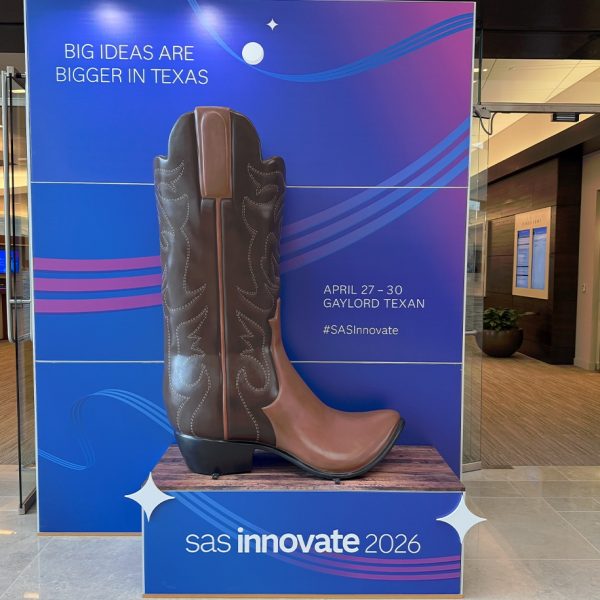

When people think about SAS Innovate, they usually picture keynotes, demos and conversations about technology. While true, what they don’t always see is the work happening behind the scenes – the creativity, craft and collaboration that help shape the experience long before attendees arrive. This year’s SAS Innovate in Texas
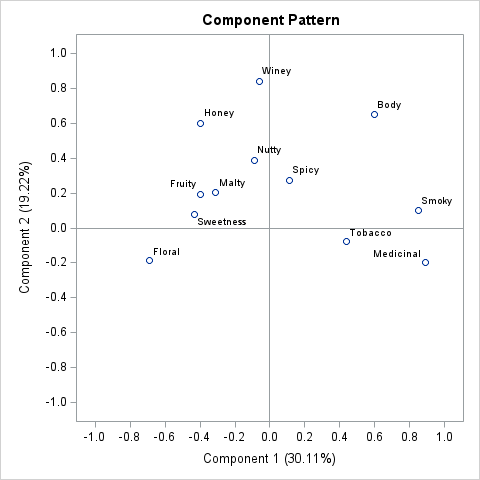

Good old Scotch drink! Inspire me, until I lisp and wink, To sing your name! -- Robert Burns (1785) Scotch whisky (spelled without an 'e') is a popular drink that makes up a multi-billion dollar industry. Scotch whisky accounts for almost 75% of Scotland's food and drink exports! Poets


SAS Innovate 2026 is building on what attendees loved last year while introducing a few meaningful updates. More content for the SAS user community SAS User Day: An afternoon dedicated to content curated by SAS User Groups from around the world, offering peer-driven sessions and practical insights. This will take


Governance, risk and compliance (GRC) frameworks are well established on paper. Most organizations have strategies, policies, risk registers and controls in place. Yet for many leaders, the reality looks quite different. Processes remain opaque. Responsibilities blur across functions. Regulatory changes trigger reactive workarounds rather than controlled execution. Audits consume excessive


For years in enterprise analytics, the focus was on capability. More data. Faster computing. Stronger models. Organizations have invested heavily in modern data platforms to close the sophistication gap. That gap is largely closed. What hasn’t closed is the execution gap. Platform teams are discovering something: even in highly mature


Most organizations encounter various complexities and bottlenecks. Whether it is due to continued economic uncertainty or shifting customer expectations. Much of this is also driven by data and AI, which are reshaping decision-making, including how societies approach labor. Ultimately, what will differentiate organizations is how they use their data and


As AI agents act autonomously in public spaces, recent incidents highlight the urgent need for strong guardrails, ethical alignment, and human judgment to ensure AI augments society rather than undermines trust, work, and human connection.

With SAS Innovate 2026 approaching, it’s a good time to step back and look at what this year’s agenda says about the state of data and AI. As in any year, speakers and presenters will cover a wide range of topics, from platform fundamentals to emerging ideas just entering production.


In the enterprise risk and fraud space, the word "creativity" has traditionally implied a lack of control. For decades, organizations have refined deterministic models – if credit score is X and debt-to-income ratio is Y, then take action Z – to ensure compliance, repeatability and stability. That approach worked because


Financial institutions are entering a new phase in credit risk modeling. AI and machine learning are no longer experimental capabilities. They are becoming central to how risk is assessed, priced and managed at scale. At the same time, regulatory expectations are evolving. The European Central Bank (ECB) has opened the

As AI agents optimize how they communicate, the shift away from human-readable language underscores why transparency and interpretability are essential for building trust in autonomous systems.

Generative AI showed up in the enterprise fast. In what felt like no time, it went from something people were experimenting with to something leaders were expected to have a plan for. Not just whether to adopt it, but how it fits into the future of their organization. Underneath all
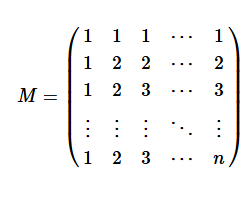
When you implement a numerical algorithm, it is helpful to write tests for which the answer is known analytically. Because I work in computational statistics, I am always looking for test matrices that are symmetric and positive definite because those matrices can be used as covariance matrices. I have previously

As AI agents gain autonomy and access to sensitive systems, emerging threats like prompt injection worms highlight how human-like security training and governance must evolve to prevent large-scale, opaque cybersecurity breaches driven by agent behavior.
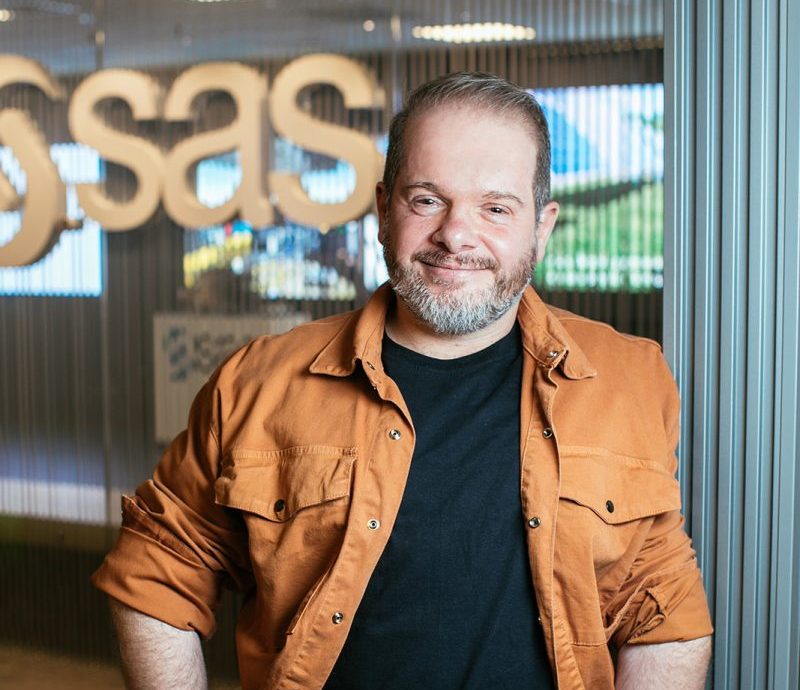

Vivemos um ponto de inflexão na governança global da inteligência artificial, que agora adentra o campo do direito internacional e da soberania estatal. As esperanças de uma regulamentação internacional unificada entre EUA e China se desvaneceram, revelando um nacionalismo da IA — fenômeno que, sob o prisma do direito comparado,