For decades, supply chain software has been defined by tools -- forecasting tools, optimization tools, scenario tools, dashboards, and planning applications. Each is designed to perform a specific task well. But as supply chains become more volatile and tightly coupled, the biggest challenge is no longer analytical sophistication. It's coordination.
Demand forecasts feed supply plans. Supply plans must be tested against scenarios. Scenarios introduce new assumptions that ripple back into forecasting. These steps are deeply interdependent, yet they are often managed by different teams, across disconnected systems, with manual handoffs in between. When conditions change, the process resets. Tools alone don't manage that complexity -- people do. And that model does not scale.
This is where the shift from tools to agents becomes consequential.
Tools execute tasks. Agents orchestrate decisions.
Traditional tools are fundamentally reactive. They take inputs, run a calculation, and return outputs. Even when tools are powerful, they operate in isolation.
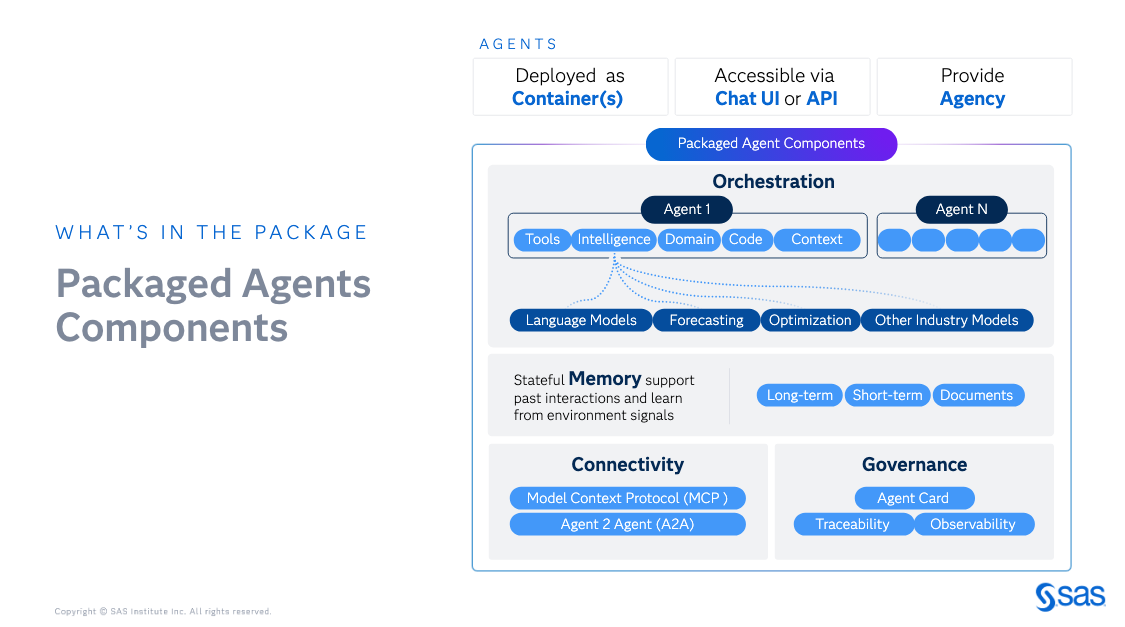
Agents behave differently. An agent is not just an interface or a conversational layer -- it is a stateful orchestrator. It understands context, manages dependencies, and coordinates decisions over time. Where tools optimize individual steps, agents manage the flow between them.
In simple terms:
- A tool answers a question.
- An agent understands why the question matters, what depends on it, and what needs to happen next.
Why this matters for S&OP
Sales and Operations Planning is not a single event or a static plan. It is a continuous decision cycle that connects demand signals, supply constraints, financial trade‑offs, and scenario evaluation across teams and time horizons.
Yet in many organizations, S&OP remains fragmented. Forecasting and optimization are run separately. Scenario comparisons happen offline. Alignment is achieved through meetings, spreadsheets, and rework. Delays are not caused by weak analytics, but by manual coordination across systems.
The SAS Supply Chain Agent is designed to address this gap.
Rather than introducing another planning tool, it acts as an orchestration layer across forecasting and optimization capabilities organizations already rely on. Forecasting and supply optimization remain specialized and rigorous, but they are no longer disconnected activities. The agent understands how demand projections drive supply decisions, how scenarios alter assumptions, and how downstream actions depend on upstream changes.
When conditions shift, the agent manages the sequence required to deliver a coherent response -- preserving context across forecasting, optimization, and scenario analysis rather than treating each request as an isolated task.
LEARN MORE | See SAS Supply Chain Agent topics at SAS Innovate 2026Data integration where decisions start
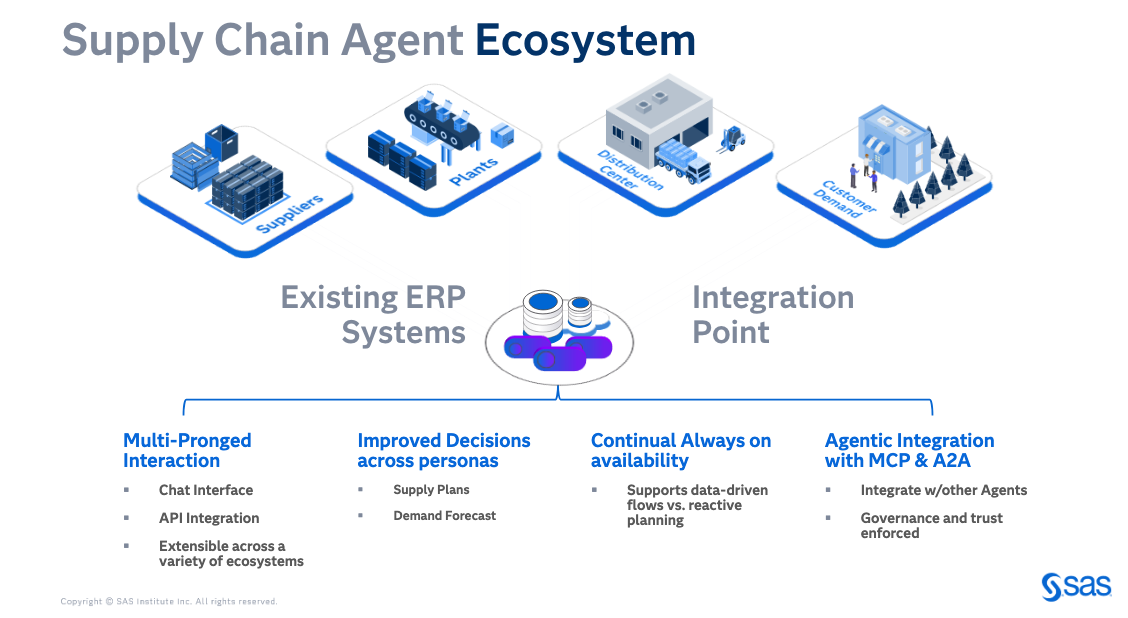
From a data perspective, this orchestration is anchored in direct integration with core enterprise systems, including ERPs and other operational data sources that underpin S&OP processes.
Instead of moving data into siloed tools and translating results manually, agents work directly with the systems where supply chain data already lives. They translate industry specific intelligence into insights that are meaningful for each role -- whether that's a demand planner validating assumptions, an operations manager evaluating constraints, or a leader assessing trade offs.
This connection to enterprise data is what allows agents to bridge analysis and action without sacrificing consistency or control.
One Agent, many decision surfaces
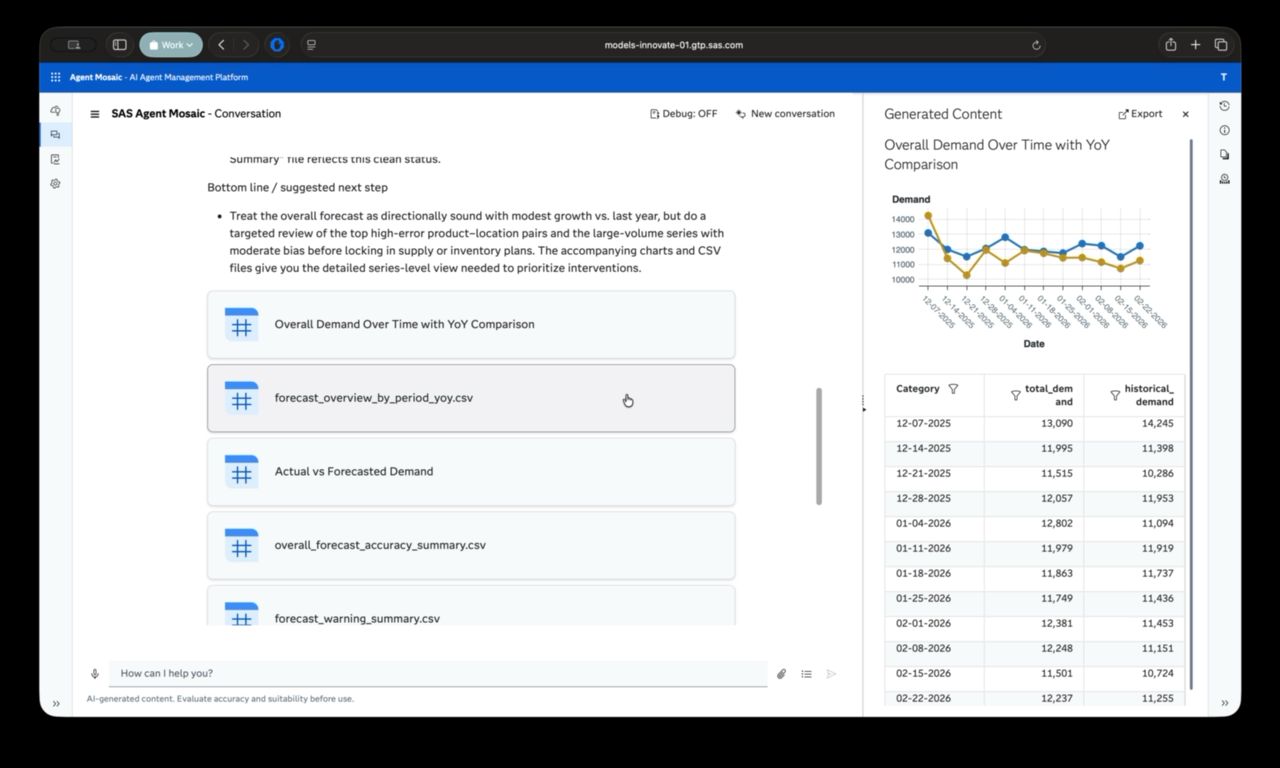
Equally important, the Supply Chain Agent is not tied to a single interface. Because orchestration logic lives in the agent itself, it can operate across multiple interaction surfaces.
A planner may explore adjustments conversationally. A supply manager may review impacts inside a planning environment. An executive may ask high level questions within a collaboration tool. Each interaction is tailored to the user, but the underlying decision logic remains consistent.
Assumptions, scenarios, and outcomes persist across users and sessions. This continuity is essential for S&OP, where confidence depends not only on speed, but on traceability and shared understanding.
Lower friction without lowering rigor
Most supply chain decisions are made by people who understand the business deeply but are not data scientists or optimization specialists. They should not need to manage parameters, data handoffs, or disconnected systems to do their jobs effectively.
By bringing orchestration into familiar environments, agents reduce friction without reducing rigor. Users work in business terms, while analytical complexity remains embedded and governed underneath. Decisions can evolve naturally, and context is preserved as plans are revisited.
Tools tend to fragment decision flows, limit interaction to more technically proficient analysts and inhibit direct analysis from domain experts. Agents unify them, by exposing the mentioned rigor within existing tools designed to appropriately serve their intended end-users.
Why this is meaningful for SAS
This is where the Supply Chain Agent is especially significant for SAS.
SAS has long been trusted for the analytical foundations of supply chain planning -- forecasting accuracy, optimization rigor, and explainability. What has changed is the need to apply those capabilities continuously and coherently as conditions change.
The Supply Chain Agent allows SAS to elevate proven forecasting and optimization assets into an orchestrated S&OP decision system. It preserves trust, determinism, and auditability while enabling faster iteration and broader access across roles.
Rather than simply adding a new interface, the agent ensures that analytics operate together as part of a living decision process.
From planning cycles to living decisions
Viewed through this lens, agents do not replace tools -- they reframe them. Tools become capabilities agents orchestrate, not destinations users must navigate.
For S&OP teams, this means faster alignment, clearer trade offs, and decisions that remain connected as supply chains evolve. This is why agents represent more than a new interaction model -- and why the Supply Chain Agent matters as a foundation for how modern supply chain decisions are made.