All Posts


This is a dramatic interpretation of an actual conversation I recently had with the CIO of one of North Carolina’s leading cities. We discussed his experience using data quality, data integration, business intelligence and analytics in the daily operation of the city. I may have taken some...well, a lot of
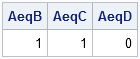

Ah! The joys of sets! It is easy to test whether two vectors are equal in SAS/IML software. It is only slightly more challenging to test whether two sets are equal. Recall that A and B are equal as sets if they contain the same elements. Order does not matter.


As summer comes to an end, I find myself getting excited about some of the regional user group conferences that take place every fall. This year, I’ll be presenting a paper at WUSS (Western Users of SAS Software) in Long Beach, CA, in early September. About one week later, I’m

Planning for SAS Global Forum 2013 is well underway and it’s time you get involved through the Call for Papers! As the 2013 SAS Global Forum conference chair, I cannot emphasize enough how much we rely on your creative tips and tricks to contribute to the invaluable content provided at

A few weeks ago I wrote an article on using the non breaking space character to prevent stripping of leading and trailing blanks in a string. Since then, I have discovered a few more instances where the nbsp can be a useful tool for creating graphs. One such instance came up last week


It’s that time of year again! The leaves are turning, the days are getting shorter, and all across the country, SAS users are getting ready for the annual users group conferences. To get people excited about the upcoming events, I’ll be hitting the road—metaphorically, at least—and virtually visiting each of


SAS users world-wide have turned to Susan Slaughter, Lora Delwiche, and The Little SAS Book to learn SAS programming. This week's SAS tip is from their bestselling fourth edition of the book (the fifth edition is now available for preorder). Whichever version of The Little SAS Book you use, you'll benefit from the friendly


One of the often-cited side effects of moving from "Base SAS" (SAS on your PC, or Display Manager) to SAS Enterprise Guide is the loss of "X" command privileges -- that is, the ability for your SAS programs to invoke other programs via the operating system shell. We call this
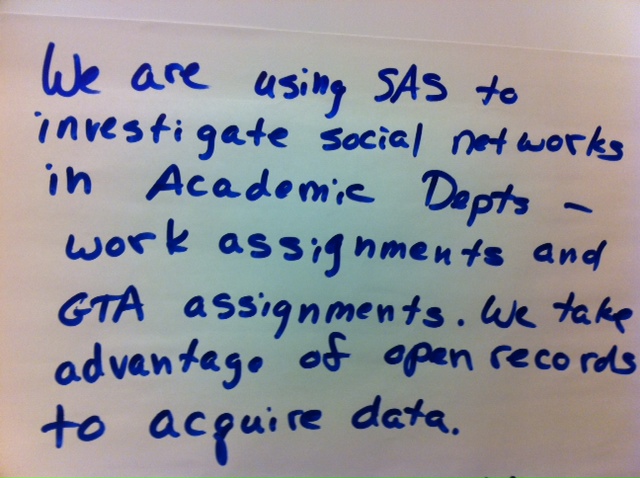

A super hot topic in most organizations is how to make the most of the troves of social data available. This Post-It Note author isn't specific about the SAS solution that is being used, so I'm going to speculate that he or she is taking advantage of SAS Text Miner, SAS Text
I follow Andrew Ratcliff's NOTE: blog, and thought you might want to check out his latest post. I've reprinted it below (you'll notice that I'm a bit behind the times): NOTE: SGF Call for Papers 2013 Opens Tomorrow #sasgf13 The Call for Papers for next year's SAS Global Forum (SGF) opens
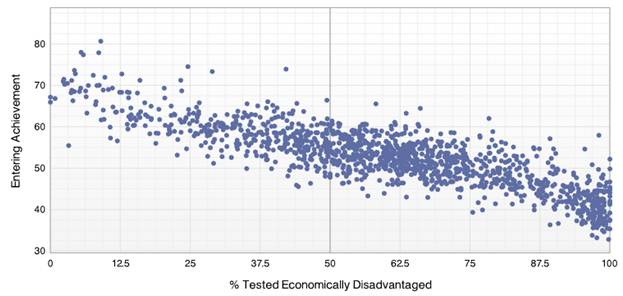

“Ohio links teacher pay to test scores” was the headline of a recent CNN School of Thought blog. Yikes! With a headline like that, teachers might start heading for the hills. I kept reading through the blog hoping that it would better explain Ohio’s policy to use student growth data
Pie charts have been the subject of some criticism when they are used to compare measures across multiple categories. It is generally accepted that comparison of magnitudes represented as angular measures from varying baselines is not effective. However here are some use cases where a pie chart does quite well. When it comes
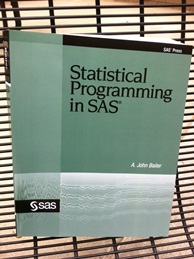
This week's SAS tip is from A. John Bailer and his book Statistical Programming in SAS. A Fellow of the American Statistical Association, John has been using SAS for 30 years. He's also Distinguished Professor and Chair of the Department of Statistics at Miami University. To read a free chapter and user reviews
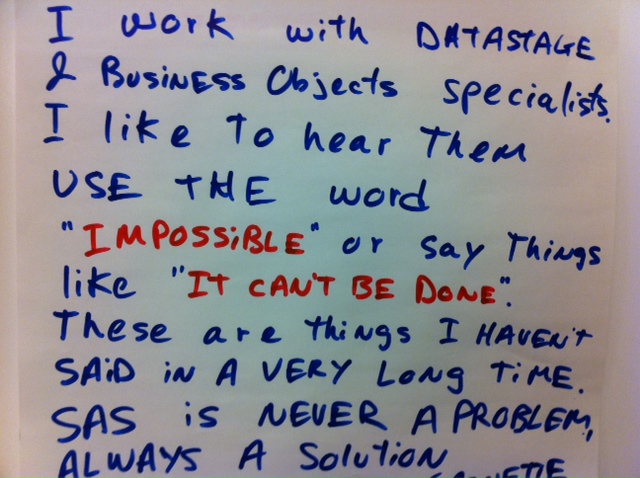
It's always great to hear that SAS users get to thump their chests a bit around statisticians and programmers who are struggling because they are trying to solve problems using software provided by those "other" companies. Now, that's inspiring.
Regular expressions provide a powerful method to find patterns in a string of text. However, the syntax for regular expressions is somewhat cryptic and difficult to devise. This is why, by my reckoning, approximately 97% of the regular expressions used in code today were copied and pasted from somewhere else.