All Posts
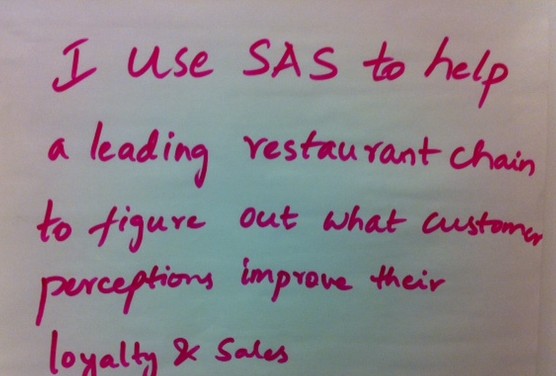

I've heard it said that perception is everything, but can you really track and measure customer perception in a way that will allow you to effect change? The answer is yes.

In a previous article we discussed how to add axis aligned statistics table to a Lipid graph using GTL. Other graphs such as the Survival Plot also utilize the same technique to display the "at risk" statistics aligned by time or visits along the X axis. Often, we also need to display


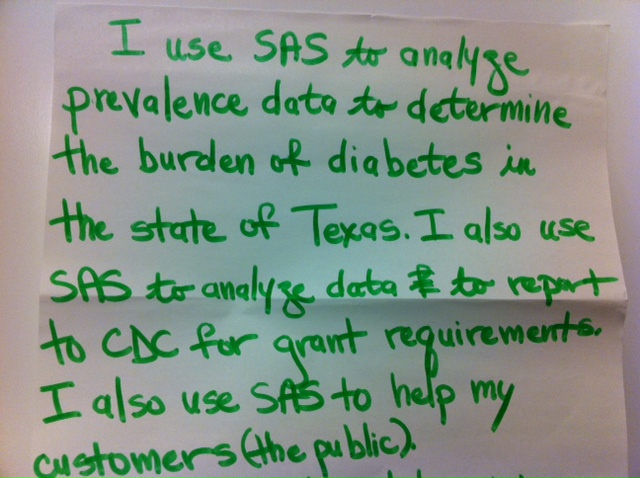
I’ve been fortunate to see a lot of the US through my work with SAS users groups. My latest trip was to Fort Worth, Texas, where I saw my first rodeo and attended the South Central SAS Users Group (SCSUG) Educational Forum.

The heatmap is a graphical representation of a table where colors are used to represent the values in the table. This is an effective graphic for finding the minimum and maximum values across the table and may surface patterns in the data. With the addition of the HEATMAPPARM statement to

If you’ve taken one of my SAS classes you may recall “Mark’s 3 rules of programming”, the first of which is “Lazy programmers are GOOD programmers.” One of the things I love about best about SAS programming is the plethora of functions and shortcuts built into the language, all designed
Rick Wicklin's blog post on using abbreviations provided a solution for a long standing pain. When writing a new GTL program for simple graph, often the bulk of the code is boiler plate. To create a simple scatter plot of weight by height, you need to type in the following program:
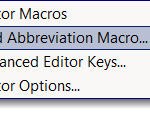

Rick posted a tip today about using abbreviations in the SAS program editor window (often referred to as the "enhanced editor"). Defining abbreviations is a great way to save keystrokes and re-use "templates" of code that you've squirreled away. (One of Rick's readers also picked up on the tip, and
In this blog we will discuss many aspects of the SG Procedures. This article will cover some basic features and workings of the SGPLOT procedure to establish a baseline. The single-cell graph is the work horse for data visualization. From the simple bar chart to the complex patient profiles for clinical


I recently attended The Education Trust’s 2011 National Conference on closing gaps and raising achievement for ALL students. This was my first Ed Trust event and I walked away baffled by the data about the inequities in our education system, and the persistent gaps between the affluent and impoverished. First,


When I moved last year from Denver to the Washington, DC area people told me to prepare myself for the long hours I would spend in my car. I had no idea. It takes forever to get anywhere. Once, during a snowstorm it took me 9 hours to drive 10
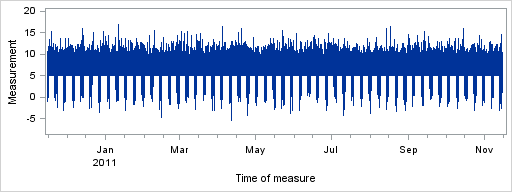
I've been working with date-time data on a recent project, and I've come across a few SAS programs that have "opportunity for improvement" when it comes time to create reports. (Or maybe I haven't, and I contrived this entire blog post so that I could reference one of my favorite


SAS said, "Hello, San Francisco!" for the Western Users of SAS Software (WUSS) conference October 12-14. The conference was chaired by Kathy Valdes, from SRI, and Ginger Carey, from Carey Consulting, two long time SAS users. With no time for Sittin’ on the Dock of the Bay, we kicked off the event -

The Unicode character table contains a vast array of characters and symbols that can be quite useful for making your text more descriptive in your graph. These characters can be inserted into any viewable string that you can define in the GTL or SG procedure syntax. These strings include titles,
The display of statistics, aligned with graphical plot of the data, is a common requirement for graphs, especially in the Clinical Research domain. In the previous post on Discrete Offset, I used an example of the Lipid Profile graph. Now, let us use the same example and add the display of statistics in