The DO Loop
Statistical programming in SAS with an emphasis on SAS/IML programs

When you use the bootstrap method in statistics, the most common resampling method is called case resampling. For data that has N observations, each bootstrap sample is created by sampling with replacement from the N observations (or "cases") in the data. However, if the data set includes categorical variables, it
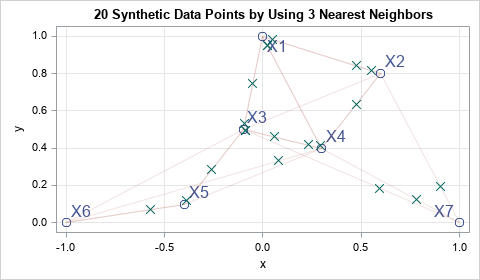
A recent article describes the main features of simulation by using the Synthetic Minority Over-sampling Technique (SMOTE). SMOTE was created to oversample from a set of rare events prior to running a machine learning classification algorithm. However, at its heart, the SMOTE algorithm (Chawla et al., 2002) provides a way
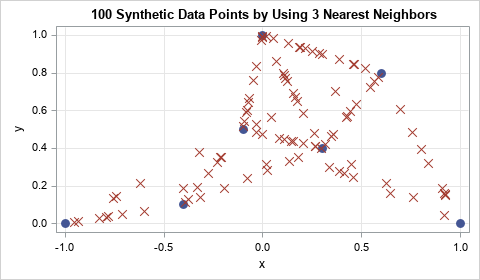
The Synthetic Minority Over-sampling Technique (SMOTE) was created to address class-imbalance problems in machine learning algorithms. The idea is to oversample from the rare events prior to running a machine learning classification algorithm. However, at its heart, the SMOTE algorithm (Chawla et al., 2002) is essentially a way to simulate