All Posts



~Contributed by Becky Graebe, SAS Communications Manager~ If there was any doubt in the minds of SAS Global Forum attendees that the computing landscape has changed remarkably in recent years, Vice President of Platform R&D Paul Kent and Research Statistician Developer Oliver Schabenberger set that idea squarely off the grid


Contributed by Bill Roehl, Data Geek at Capella University (@garciasn) Analysts love raw data and end-users love to see that same data displayed in beautiful charts and pictures with exciting color. Dr. Danni Bayn, a Research Analyst at Capella University in Minneapolis, provides a drop-in method for SAS users to

~Contributed by Philip Busby, Applications Developer at SAS (@Philihp)~ My mind was blown just now at Paul Gorrell's talk on numeric values within SAS. The nice thing that hooks new programmers to SAS is how easy it is to do so many things, but what I find really makes a
JMP founder John Sall talks about the new, exciting features in JMP 9 and why he likes to attend SAS Global Forum.
Contributed by Kirsten Hamstra, SAS Social Media Manager Prolific blogger and author of SAS for Dummies Chris Hemedinger knows maybe a little too much about his Facebook friends. Presenting his paper titled “Social Networking and SAS: Running PROCs on your Facebook Friends,” Chris shared basic techniques to analyze your friends


The federal government is more aggressively pursuing health care fraud, and helping the states do the same, by proposing funding changes and investing in new technologies. A newly proposed rule would allow 90% Federal Financial Participation (FFP) for data mining initiatives in state Medicaid Fraud Control Units (MFCU’s). Another proposed

Yesterday I was in the Big Room for the rehearsal of the Technology Connection, the part of SAS Global Forum where SAS shows off its wares: what's been released recently and what's coming. I believe that customers are going to love what they see. And just about every product that
While talking to fellow SAS users at SAS Global Forum 2011 this week, I'll be discussing how SAS programmers can "play" with social media data that they can access on Facebook and Twitter. I always refer people to my blog for more information, and so I've prepared this blog post

Editor's Note: This article was an April Fool's prank from 2011. The entire article is fake. Today, SAS, the leader in business analytics announces significant changes to two popular SAS blogs, The DO Loop (written by Rick Wicklin) and The SAS Dummy (previously written by Chris Hemedinger). The two blogs
"Twitter, thou art nought but data." So sayeth the SAS programmer. Many data analysts now recognize Twitter for what it is: a tremendous source of data covering almost any topic, from Justin Bieber's hair to political uprisings to technical conferences to company brands. SAS offers sophisticated solutions to harness this
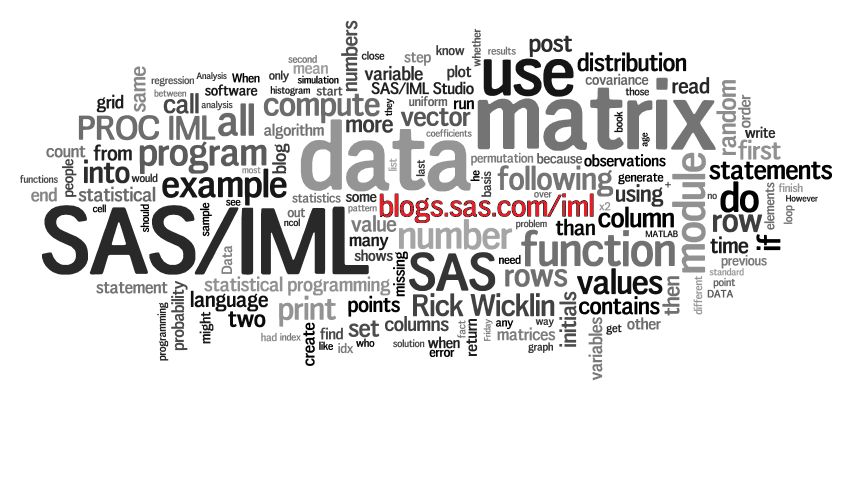
This week, I posted the 100th article to The DO Loop. To celebrate, I'm going to analyze the content of my first 100 articles. In December 2010, I compiled a list of The DO Loop's most-read posts, so I won't repeat that exercise. Instead, I thought it would be interesting


Let’s start with a quiz. Which of the following is the Programmer’s Rule # 1? 1. Expert knowledge of multiple languages, like SAS and Java 2. Talent to maneuver with complex algorithms 3. Innate ability to draw flowcharts 4. None of the above Dear reader, as a savvy programmer, you
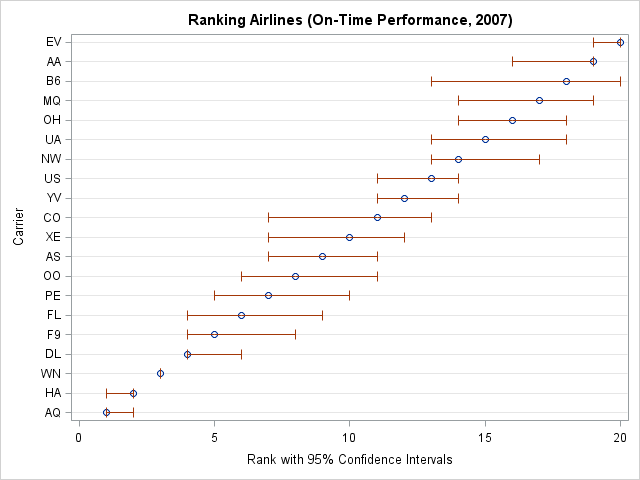
In a previous post, I described how to compute means and standard errors for data that I want to rank. The example data (which are available for download) are mean daily delays for 20 US airlines in 2007. The previous post carried out steps 1 and 2 of the method

Many SAS users love "undocumented features" within SAS software that they have found or heard about. Sometimes they can be really useful, and the fact that they are undocumented adds to the mystique. Some users have written entire conference papers on the subject. After 35 years of evolution, SAS contains