All Posts


Does your site have multiple people maintaining a single deployment of SAS? Is it important for them to maintain a clear audit trail of who is doing what exactly? Or do you need to update your SAS deployment using different userids? Let's take a look at some techniques to manage


This year the Super Bowl will take place in East Rutherford, New Jersey at MetLife Stadium just outside New York City. For the first time in this event’s 48-year history, the game will take place outdoors in a cold-weather environment, potentially subjecting players and fans to sub-freezing temperatures. The fans


As I embark on 2014, I reflect upon the many competing, yet interdependent, tensions discussed in education circles in 2013. In conferences, classrooms and statehouses, adults who care about kids debated the best ways to implement: New academic standards (Common Core State Standards or other College and Career Ready Standards)

Users have often expressed the need for more marker symbols. ODS Graphics supports over 30 scalable marker symbols, both filled and empty. As mentioned in an earlier article, with SAS 9.4, filled markers can now have outlines and fills, and can also have special effects. Also with SAS 9.4, now you
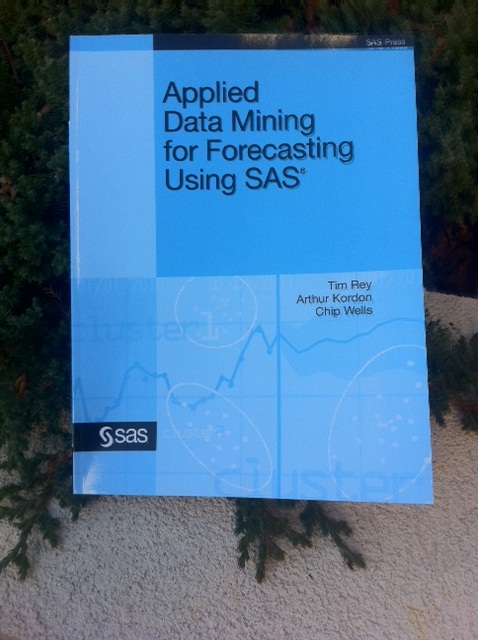

This week's SAS tip is from Applied Data Mining for Forecasting Using SAS by Tim Rey, Arthur Kordon, and Chip Wells. Whether you're a forecasting practitioner, engineer, statistician, or economist, you'll appreciate the many real-world examples in the book. And hopefully this free excerpt. The following excerpt is from SAS Press


Performance management systems are becoming more important to local governments across the country. This is true for several reasons. Citizens are calling for a more accurate accounting of how their tax monies are being spent. Local government revenues have not been growing as much as in the past and, in


I remember exactly where I was when I heard that Marje Fecht was selected as the conference chair for SAS Global Forum 2014. This was April 2011, and I was at PURE Nightclub in Las Vegas. That's not my usual "clubbing" scene, but we were at the kickback party for

Even though I’ve worked as software technology marketer over the years, I have to admit that on a personal level I’ve probably related more to TV programming than software programming. When it comes to writing, I’ve always gravitated more toward crafting marketing communications than code. And when it comes to


In a previous post, I showed you how to send graphs with charttips & drilldowns in an email ... but what if you also need to send the graphs that you're drilling-down to? You guessed it - SAS also has a slick trick for doing that! When you create SAS graphs


In the movie, The Matrix: Reloaded, our heroes and the KeyMaker frantically navigated from world to world through a series of doors and locks trying to escape the villains. Fortunately for our heroes, the KeyMaker always had the right key on his ring, he just had to know what key
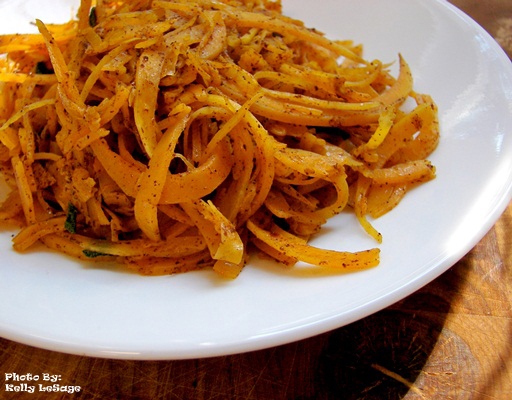

I’m usually not one for gadgets. I tend to like practical things that I will use often. However, when I started seeing different recipes around the internet using zucchini, butternut squash or sweet potato noodles, I was intrigued!

I began 2014 by compiling a list of 13 popular articles from my blog in 2013. Although this "People's Choice" list contains many articles that I am proud of, it did not include all of my favorites, so I decided to compile an "Editor's Choice" list. The blog posts on
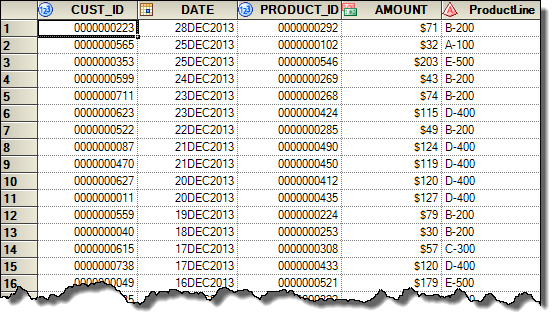
Recency, Frequency, and Monetary Analysis (or RFM) is a popular customer segmentation technique employed by database marketers everywhere. Marketers use RFM to identify which customers are most likely to respond to a direct marketing campaign. The model takes into account three simple metrics: How recently did the customer buy from
A large variety of graphs fall in the category of what I call a "Single-Cell" graph. This type of graph consists of a single data region along with titles, footnotes, legends and other ancillary objects. Legends and text entries can be included in the data area. The data itself is displayed
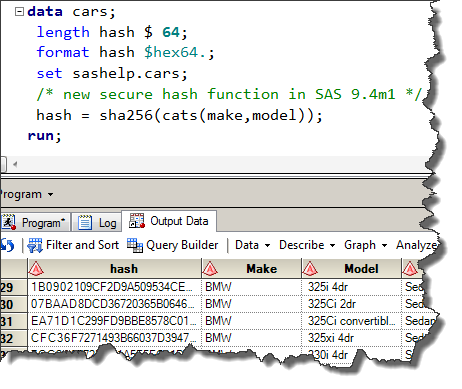
SHA256 and other hash functions are supported in SAS 9.4 and SAS Viya. It's better than MD5 as a cryptographic hash!