All Posts

The graphs produced by the SG procedures (and GTL) have a default look and feel designed for the common use cases. However, everyone has a preference for some special features that make the graphs unique. Fortunately, extensive customizations can be made to graphs produced by these tools using statement and

John Taylor likes computer data the way he likes big trout: here, there or anywhere. Which is perfectly natural, considering he’s the data analyst in the Inland Fisheries Department at Texas Parks and Wildlife. Taylor describes his unspoiled enthusiasm for big data and big fish in this sendup of Dr. Seuss that
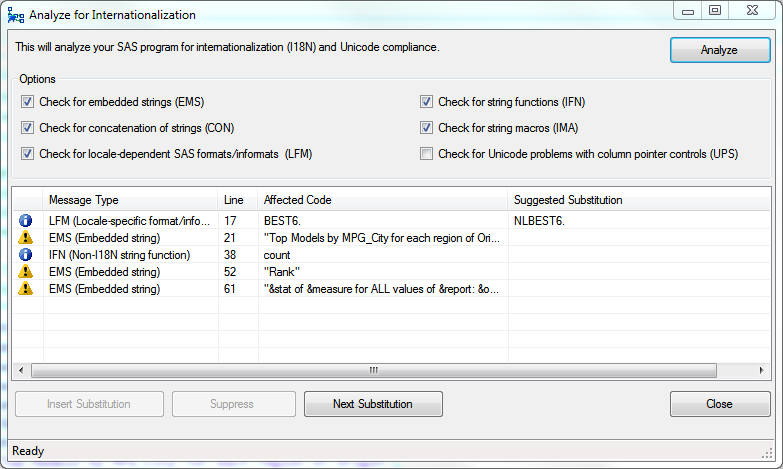

If you're a software developer, you're probably already familiar with these terms: I18N and L10N. Internationalization (I + 18 letters + N = I18N) The discipline of preparing your software to run correctly in different languages with different culture settings. For example, the software must be able to accommodate multibyte


An updated version of the SAS Hot Fix Analysis, Download and Deployment Tool (SASHFADD) has just been released on the SAS Technical Support Hot Fix site. If you are not familiar with SASHFADD (pronounced SAS-H-F-ADD), it’s a tool that will analyze a SAS 9.2, SAS 9.3 or SAS 9.4 deployment

With the pervasiveness of mobile devices, being able to read while “on the go” has been easier than ever. How many times have you found yourself in a situation where you pass the time waiting by reading something on your phone/iPad/tablet etc? With eBooks on my iPad, I find that
As promised, here is a better combined AE-CM graph, using some of the UI improvements suggested by our UI expert, Riley. His suggestions helped to reduce the clutter in the graph, while still keeping all the features preferred by our users. Click on the graphs for a higher resolution image.

With the release of SAS 9.4 (which included SAS/STAT 12.3 and SAS Enterprise Guide 6.1), you might seriously consider hiring a Chief Versions Officer (CVO). Fortunately, most of the recent versions of SAS Enterprise Guide work with the different recent versions of SAS, so you have some flexibility as you


Missing San Francisco already? I caught up with the SAS Global Forum 2013 paper winners and asked them to share some of their insights about their work, the conference and what they took away from the experience. To kick off this series, I've posted their words of wisdom for other SAS Users. The question was
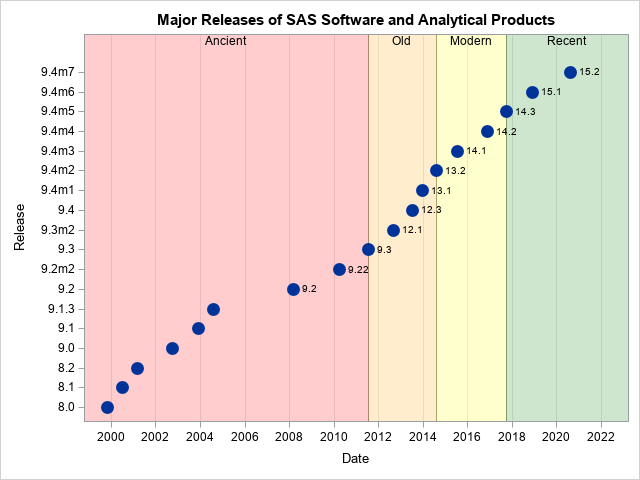

How old is your version of SAS software? The graph on the left shows the release dates for various releases of SAS software, beginning with SAS 8.0. The graph is based on a graph on Jiangtang Hu's blog that shows the major SAS releases up through the initial release of
At the SAS Global Forum 2013 in San Francisco, I presented a paper on making Patient Profile Graphs using SAS. You can follow the link to see the graphs presented in this paper. In that paper, I presented ways to create AE, CM, VS and Lab graphs. I discussed aligning the

Previously I've described how you can use SAS Enterprise Guide to send an e-mail message using Gmail as your e-mail provider. In the article, I mentioned that you can also write SAS programs that send e-mail messages, but at the time you could not reach Gmail using the FILENAME EMAIL

Users often ask if there are any major tuning efforts that need to be made in order for SAS to execute ideally in a virtual environment. The quick answer is "not really". The longer answer is “it helps to set up your virtual environment properly.” There are a few minor
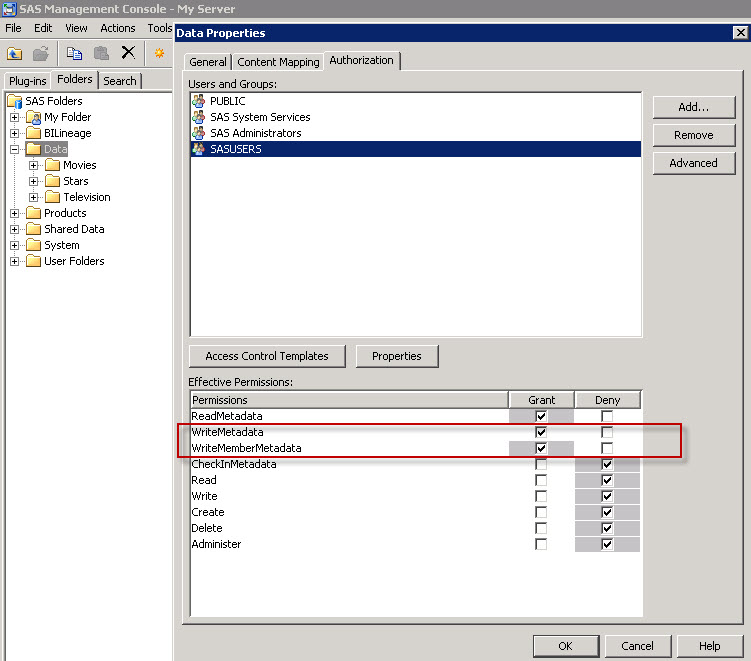

From an Enterprise Guide user's perspective, a SAS library is a library. Whether it was defined in the autoexec or in the metadata or by magic, it is there for them to use with no issues. However, there is a difference as metadata defined libraries do not behave in the
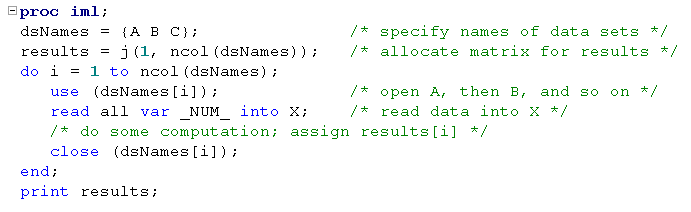
One of my favorite features of SAS/IML 12.1 (released with 9.3m2) is that the USE and CLOSE statements support reading data set names that are specified in a SAS/IML matrix. The IMLPlus language in SAS/IML Studio has supported this syntax since the early 2000s, so I am pleased that this
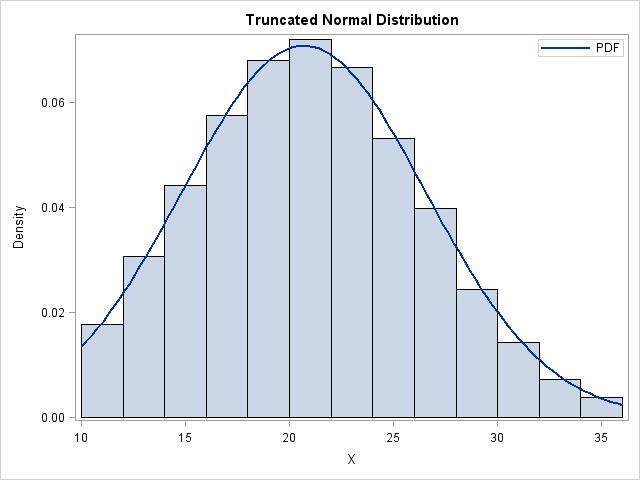
The truncated normal distribution TN(μ, σ, a, b) is the distribution of a normal random variable with mean μ and standard deviation σ that is truncated on the interval [a, b]. I previously blogged about how to implement the truncated normal distribution in SAS. A friend wanted to simulate data