In this post, we take a closer look at how AI-Driven Entity Resolution on SAS Viya is evolving through no-code accessibility, advanced record linking methods, and integration with industry-specific use cases.
Entity resolution has long been a foundational capability in analytics—connecting records, reducing duplication, and building a trusted, 360-degree view of people, organizations, and relationships. But in today’s data landscape, fragmentation is no longer an exception; it is the norm. Organizations routinely manage millions, sometimes billions, of records spread across disconnected systems, where duplicate and inconsistent identities introduce risk, inefficiency, and blind spots.
This has a significant impact. Gartner estimates that poor data quality costs organizations an average of at least $12.9 million per year. Yet despite this cost, many organizations struggle to improve. Data quality is not a one-time effort. It is continuous and operationally difficult to sustain. According to the 2024 State of Data Quality report by Transforming Data with Intelligence (TDWI), only 14% of organizations have automated data quality management processes. While more than half generate data quality metrics, just 17% formally and consistently report them. This limits their ability to manage duplication and identity fragmentation at scale.
What’s changed is not the importance of entity resolution, but the expectations placed on it. As data becomes more distributed and dynamic, organizations can no longer rely on batch processes, manual review, or isolated analytical workflows. They need identity resolution that is reliable in production, scales globally, and integrates directly with decision-making systems.
This shift is driving the evolution of SAS AI‑Driven Entity Resolution from a powerful analytical capability into a globally available, industry‑ready solution on SAS Viya.
A brief look at the SAS AI‑Driven Entity Resolution Model package
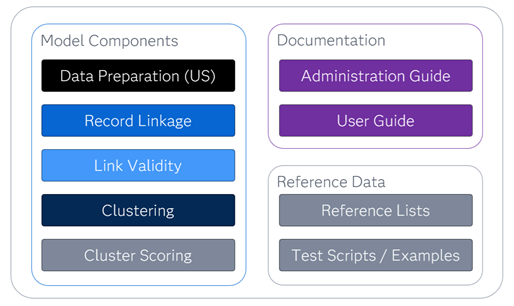
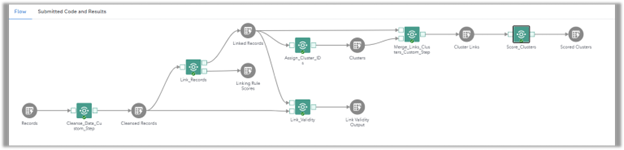
As shown in Figure 1, SAS AI‑Driven Entity Resolution is delivered as a ready‑made SAS model package. It is built as a modular pipeline that includes data cleansing, record linkage, community link validity, clustering, and cluster scoring. Organizations can deploy the full pipeline end‑to‑end or integrate individual components alongside existing data quality or entity resolution processes.
Most SAS AI‑Driven Entity Resolution components are globally applicable by design. This enables the deployment of entity resolution across regions and data sources. The data preparation component currently focuses on U.S. English standards for individuals and organizations, while the remaining linkage and scoring components are language, region, and entity-agnostic. This allows organizations to pair SAS AI‑Driven Entity Resolution with localized data preparation strategies as needed.
Lowering the barrier with no‑code configuration
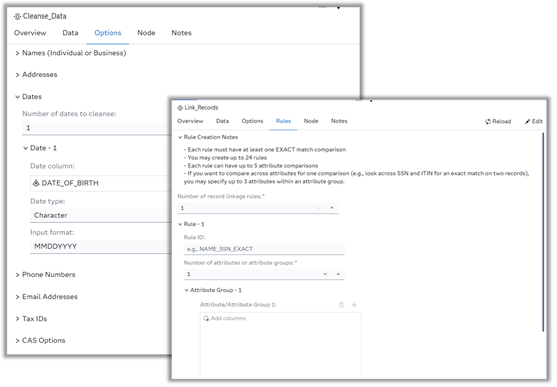
To accelerate adoption, SAS AI‑Driven Entity Resolution is available through SAS Studio Custom Steps (Figure 2) and SAS Studio Flows (Figure 3). This provides a no-code approach to configuring and orchestrating entity resolution pipelines. This enables analysts and domain experts, not just developers, to design and deploy entity resolution pipelines with confidence.
By reducing operational complexity and standardizing configuration, custom steps help teams move more quickly from experimentation to production. This is an essential capability as entity resolution expands across industries and geographies.
Why entity resolution is evolving
Traditional, deterministic matching techniques remain effective when data is clean, identifiers are stable, and match criteria are straightforward. In practice, however, real‑world data is often incomplete, inconsistent, and constantly changing. So, rule-based approaches struggle to keep pace with evolving data. This has driven increased demand for methods that learn from data patterns rather than rely solely on fixed rules.
In the Summer 2026 release, SAS AI‑Driven Entity Resolution expands support for probabilistic record linkage. This will enable matches to be evaluated based on likelihood rather than exact agreement. Enhancements include frequency-based weighting for rare and common attributes (such as first and last names), helping to distinguish meaningful similarity from coincidence. Additional capabilities, including process tracking and lifecycle management, allow identities to evolve over time, preserving historical context while continuously refining matches as new data arrives.
Together, these improvements shift entity resolution from static, rebuild‑oriented processes to entity resolution to a living system aligned with long‑running operational use.
From cross-industry capability to industry solutions
While entity resolution is a common requirement across many domains, its application varies widely by industry. The greatest value comes not from record linkage alone, but from embedding entity resolution into industry‑specific workflows and applications.
A clear example of this approach is public-sector program integrity. In food assistance programs, for instance, accurately resolving individuals, households, and related entities is essential to reducing improper payments while protecting eligible families. This need became especially visible during the COVID-19 pandemic. States were required to identify children eligible for free or reduced-price school meals. The system then linked them to the Supplemental Nutrition Assistance Program (SNAP) and EBT systems across separate education and human services data sets.
With no direct identifier to link students across these disparate systems, SAS supported states by applying probabilistic entity resolution to match students. SAS leveraged the same algorithmic techniques that underlie SAS AI‑Driven Entity Resolution. In one such implementation, this approach delivered a 30% improvement in match rates over deterministic methods. This created faster benefit distribution and reduced duplicate or missed payments. This drove an estimated $500,000 in immediate cost avoidance while supporting a 48-hour response time.
The next step is clear: Integration with industry solutions. Work is already underway to incorporate SAS AI‑Driven Entity Resolution into the SAS Payment Integrity for Food Assistance model. This would help support fair, accurate decision-making across fragmented systems and complex eligibility scenarios. This marks a crucial step in moving beyond standalone analytics into end-to-end industry solutions.
A similar pattern applies in financial services, where entity resolution is foundational to fraud detection and anti-money laundering. Understanding networks and relationships is often as critical as matching individual records. In these environments, the Real-Time Entity and Network Generation serves as the backbone for identity management. This is particularly true when paired with SAS Visual Investigator, while SAS AI‑Driven Entity Resolution enhances match accuracy through probabilistic techniques. Ongoing efforts focus on bringing these capabilities together to improve match quality and reduce false positives without disrupting existing architectures.
From financial services and public-sector programs to healthcare and life sciences, this industry-focused approach results in a stronger, more resilient foundation. It scales with data complexity and operational demand while tuning for industry-specific challenges. SAS AI‑Driven Entity Resolution offers advanced, probabilistic matching and scoring to surface relationships in complex or ambiguous data. It integrates seamlessly with your existing entity resolution workflows, delivering value across industries. Therefore, the result is an entity resolution product that is both analytically robust and operationally dependable, supporting critical decisions across diverse business domains.
A foundational model package built to evolve
SAS AI‑Driven Entity Resolution is evolving from a standalone record‑linkage capability into a globally available, industry‑ready model package for entity resolution. No‑code configuration lowers the barrier to adoption, probabilistic methods improve match quality, and lifecycle management enables continuity over time. Most importantly, integration with industry solutions ensures that entity resolution delivers value where it matters most, within applications and workflows that drive real outcomes.
This is not a change for the sake of change. It is a deliberate evolution aimed at helping organizations build trusted identities that scale across data, industries, and time.
READ MORE | AI to the rescue: How SAS is fixing food stamp errors and helping families in need