
Every lottery ticket printed is a forecast – and when that forecast is wrong, the consequences are immediate.
“If the ticket’s there, you buy it. If the display is empty, you walk away,” said Kyle Gray, Insights and Analytics Manager at the North Carolina Education Lottery. “That moment is forecasting.”
Gray’s point was simple: forecasting failures don’t show up as abstract accuracy metrics. They show up as tied-up inventory, missed revenue and customers who never come back.
Previously, the organization treated forecasting as a modeling problem, said Gray. If the results were off, teams refined the math. That approach missed the real issue.
“We didn’t lack analysts,” Gray said. “We lacked a unified system.”
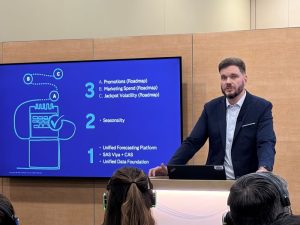
Retail, digital, loyalty and promotions data lived in separate environments. Forecast cycles stretched from days into weeks. By the time insights were ready, conditions had already changed.
The breakthrough came when the team stopped asking how to improve individual models and started asking how to improve the forecasting system itself.
“Forecasting isn’t a model problem,” Gray said. “It’s a systems problem.”
Using a unified data foundation built on SAS® Viya®, the organization brought disparate data sources into a single environment where data, forecasts, scenarios and decisions could live together.
With action-ready data sets, Gray's team went from creating "one-time reports to scenario-ready outputs," giving them the opportunity to think creatively about what questions they can answer when they include seasonality data, marketing spend and jackpot volatility in their forecasts.
Forecasting the future confidently
The results are impressive. Forecast cycles dropped from weeks to hours. Accuracy improved by 5.9% across a $2.85 billion product category.
According to Gray, agility was even more important than accuracy.
Faster forecasts meant more confident planning, better timing and quicker allocation decisions across product, marketing, finance and digital teams. Forecasting evolved from a retrospective report into shared infrastructure, something that coordinated the business rather than just reacting to it.
“Forecasting stopped being an output,” Gray said. “It became a coordination mechanism.”
Gray shared these insights during his session, Forecasting the Future of Play: Transforming Lottery Analytics with SAS Viya, at SAS Innovate 2026, where he closed with a challenge to every organization in the room.
“The question isn’t whether we forecast,” he said. “It’s whether our system is worthy of our strategy. Forecasting doesn’t just predict the future. It shapes how confidently we move toward it.”