
For years in enterprise analytics, the focus was on capability. More data. Faster computing. Stronger models. Organizations have invested heavily in modern data platforms to close the sophistication gap.
That gap is largely closed. What hasn’t closed is the execution gap.
Platform teams are discovering something: even in highly mature environments with integrated data, production models and interactive dashboards, decisions still hesitate. Insight exists, but momentum fades between exploration and action.
The problem is no longer analytical power.
It’s analytical continuity.
In the first blog in this series, we explored how SAS® Visual Analytics helps reduce the distance between a question and an answer. By combining interactive visualization, automated insight and advanced analytics within SAS® Viya®, analytics becomes faster, more intuitive and more accessible across the organization.
But as many platform teams discover, reducing friction in analytics doesn’t eliminate it entirely. Even when data is integrated, models are built and dashboards exist, insight can still stall. When that happens:
- Analysts spend time managing data instead of exploring it.
- Business users are hesitant, unsure of what they’re seeing or what to ask next.
- Data scientists struggle to translate advanced analytics into decisions that others can act on.
That gap is context. That’s the tension platform users live with every day and it’s exactly where augmented analytics begins to matter.
From infrastructure to insight partnership
Traditional analytics platforms were designed around a quiet assumption: the user already knows what they’re looking for. The platforms assume the user knows the question, how to structure the data and how to interpret the result. That assumption breaks under real enterprise conditions:
- Data is multidimensional and interconnected.
- Questions evolve mid-analysis.
- Teams span analysts, business users and executives with very different fluency levels.
In practice, insight forms iteratively. It's messy, nonlinear and requires interpretation in motion. This is where augmented analytics proves its value, not as automation but as orientation.
SAS Viya Copilot for Augmented Analytics in SAS Visual Analytics reflects that shift.
Not automation without transparency.
No answers without explanation.
But support, embedded directly in the flow of work.
Essentially, the moment between "I see something" and "I understand what to do about it."
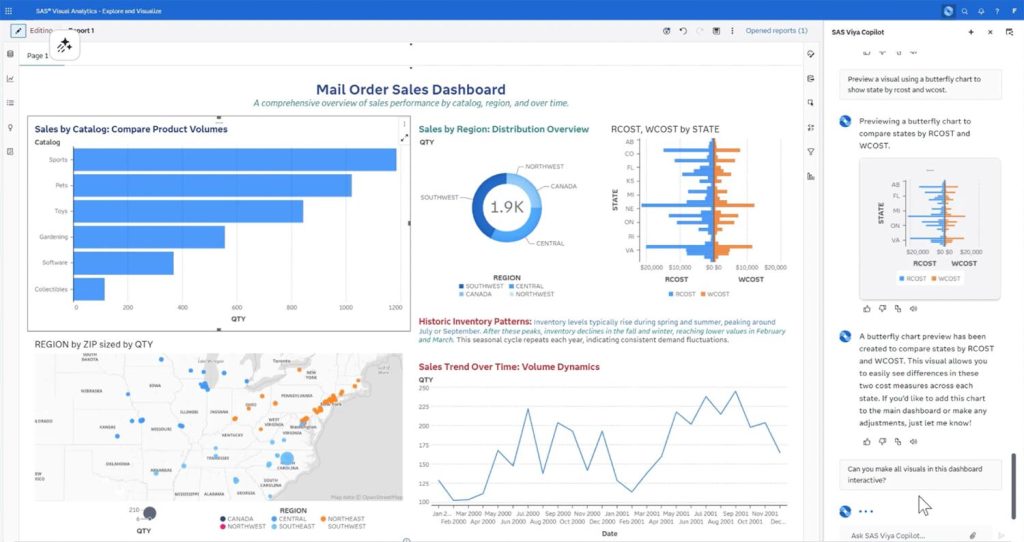
When analytics becomes conversational
By now, many SAS Viya users are already familiar with Copilot and the capabilities it introduces across the SAS Viya environment. The more interesting question is not what Copilot does, but how it changes the analytical experience inside SAS Visual Analytics.
For teams working within a modern data and AI platform, the challenge has rarely been generating analytics. The challenge has been maintaining momentum as analysis unfolds – moving from exploration to interpretation, from visualization to explanation, without constantly breaking context or switching between tools.
This is where Copilot begins to change the dynamic.
- Questions surface and can be explored immediately.
- Refinements happen without reconstructing work.
- Interpretation occurs closer to the moment insight forms.
The experience becomes more about sustaining a thread of reasoning.
Inside SAS Visual Analytics, this shows up in familiar moments:
- Building where new report pages or visual elements can be created and shaped more quickly as ideas emerge.
- Refining where existing analyses evolve through small adjustments rather than repeated rework.
- Interpreting how summaries, explanations, and contextual questions help clarify what the data actually show.
Copilot helps users spend more time interpreting insights and less time managing processes.
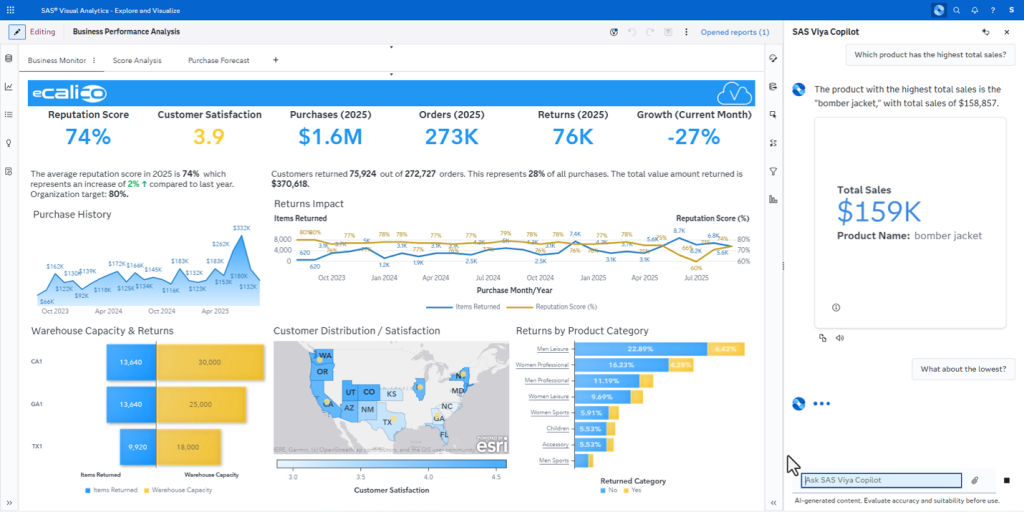
Designing analytics that people use
Enterprise analytics platforms rarely fail because they lack capability. The struggle because capability alone doesn't drive usage.
Advanced analytics only creates value when it’s usable in everyday decisions, not just by data scientists, but by the broader organization.
Most adoption efforts focus on enablement: more training, more documentation, more dashboards. Yet platform teams still end up acting as translators, bridging the gap between complex outputs and practical action.
Augmented analytics helps translate complexity into clarity:
- Reducing barriers for less technical users.
- Supporting consistency and confidence across teams.
- Helping insights move beyond specialists to decision-makers.
Less time translating equals more time creating impact.
Trust still comes first
In enterprise environments, speed means nothing without confidence.
As analytics become more conversational and embedded in daily tasks, the obvious concern follows: Does the user understand where the insight comes from, how it was generated and whether it can be relied upon?
Inside SAS Viya, Copilot operates within the same governance, transparency and privacy framework that underpins the broader platform. Users remain accountable for decisions. Outputs remain transparent. Controls remain intact.
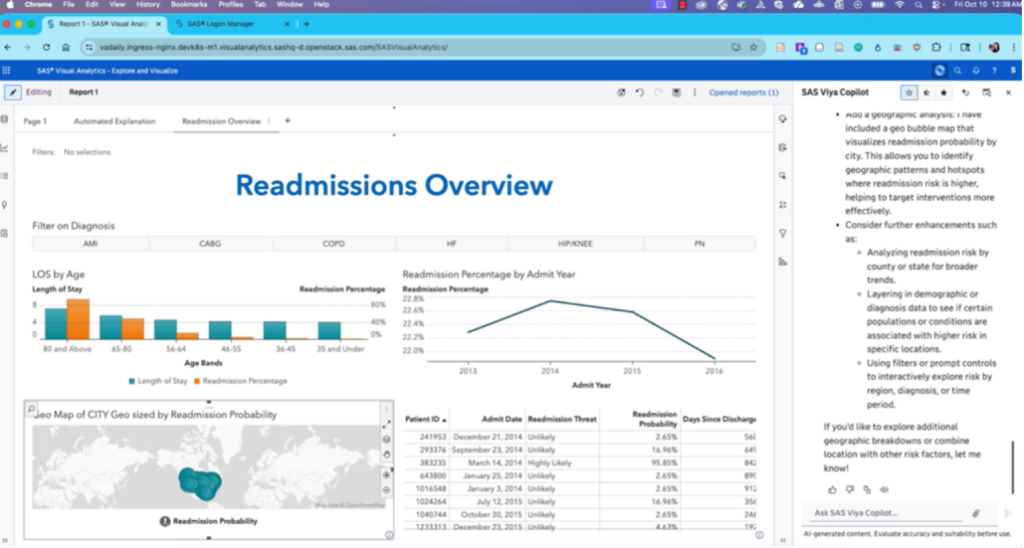
The foundation of SAS Visual Analytics hasn’t changed. Interactive analytics, explainability and governance remain core. But now, the platform no longer just presents insight – it participates in how insight develops.