The DO Loop
Statistical programming in SAS with an emphasis on SAS/IML programs

A previous article shows how to convert a positive integer from base 10 to any other arbitrary base. For example, 15 (base 10) = 120 (base 3) because 15 = 1*32 + 2*31 + 0*30. Representing integers is probably familiar to many readers. But did you know that you can
While many applications of Monte Carlo techniques use pseudorandom numbers, some applications that involve integrals are more accurate when you use quasirandom numbers, which, despite their names, are not random but are deterministic sequences of numbers. Many of these sequences are constructed by representing base-10 numbers in a different base.
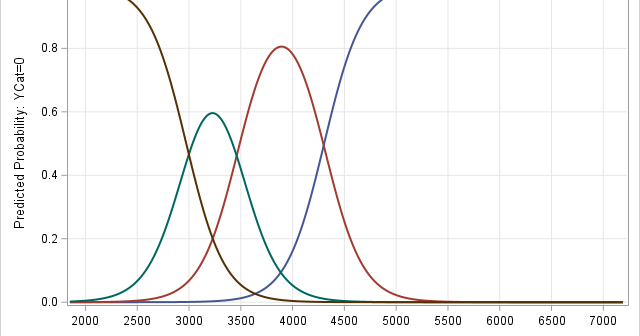
Many data analysts are familiar with logistic regression, where the response variable, Y, has two observed values, often represented as Y=0 and Y=1. The case Y=0 encodes that an event did not happen. For example, a patient did not experience some disease or did not die. The opposite case (Y=1)