We’ve already heard from more than 900 SAS users! Now we need to hear from you!
SAS has long believed that demand for people with analytics skills will continue to grow - especially given the big data challenges ahead. In fact, we love the way that Google's Chief Economist Hal Varian talks about this explosion in growth: statisticians will be sexiest job of the next decade. This
With an exponential growth in transactions, it may be hard to get a clear, single view of customer interactions. ICICI Bank , India's second largest bank, needed a single system that could replace multiple (complex to maintain) reporting systems - enterprise wide. The challenge - finding a solution to handle its growing
When I started using SAS back in 1995, every SAS user was a SAS programmer. We wrote code, and we were proud of it! We accessed our data via the DATA step, PROC IMPORT and SAS access engine code. If you had asked me back then what metadata is, I’m
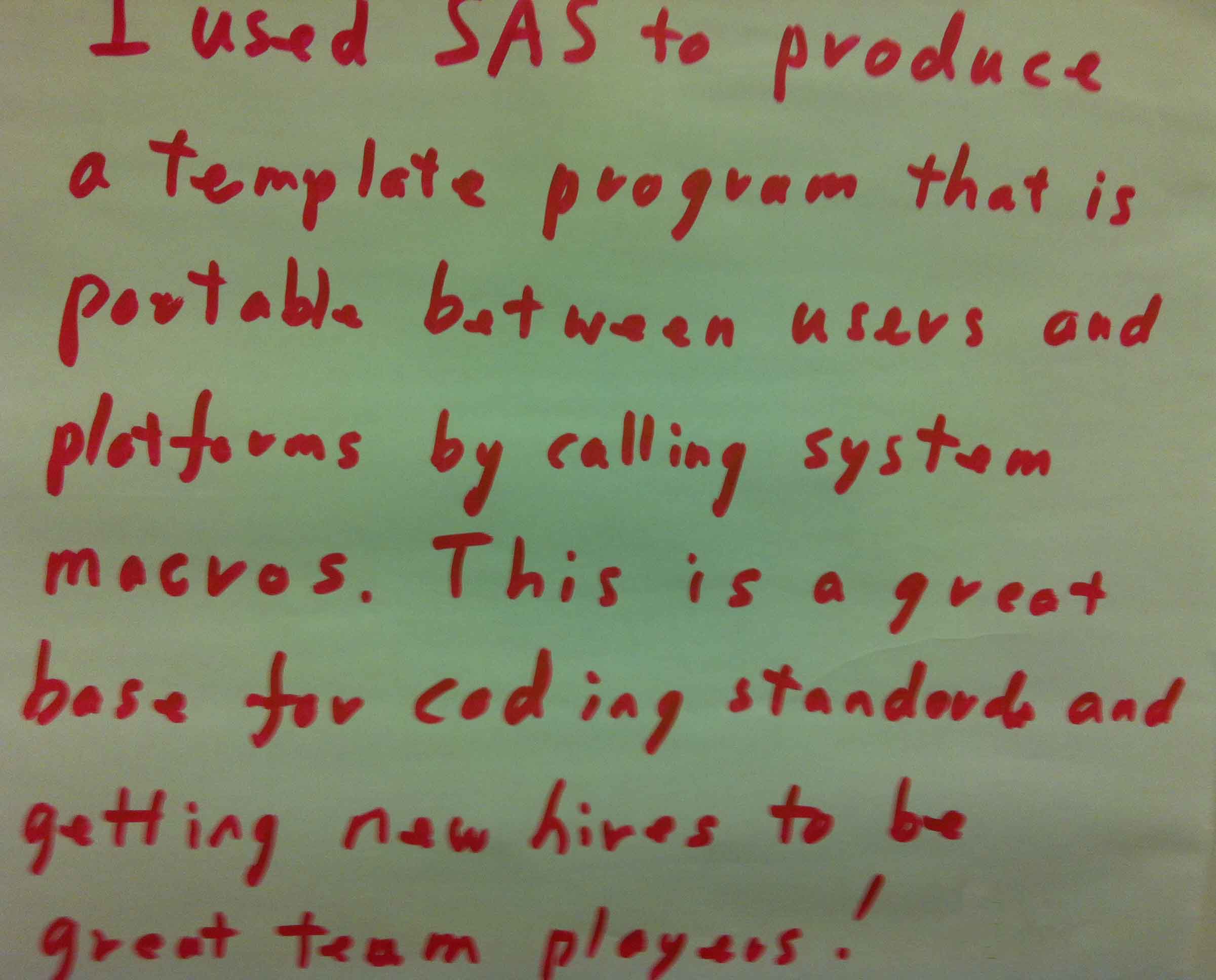
Collaboration can be difficult, but what if you could provide a template that helps everyone work together more efficiently? The Post-It note author below has developed such a tool and suggests using it as a guide for accepted coding standards. You can also use templates to control the look of
Apply now for the SAS Global Forum Junior Professional Award. Only 20 professionals will be selected. Congratulations to the SCSUG awardees!
Recently, I shared a summary of Brian Varney’s SESUG presentation on How to document your SAS environment. One important step was determining where files that control overall processing, such as autoexec.sas files, are deployed. For installations on a single server or platform, Varney suggested using the OPTIONS procedure, which lists
Jenine Milum is the Vice President and Analytics Manager at Wells Fargo Bank. About 10 years ago, she learned a valuable, but little known solution to cutting the CPU processing time when dealing with large data sets. "We were processing log activity for our website on a daily basis," says Milum,
Have you used the MEANS procedure to calculate frequencies: for several variables in the same step? without sorting the data first? without checking for missing values? using the TYPE statement and the CLASS statement together? At the recent SouthEastern SAS Users Group conference, Janet Willis shared what can go wrong
Kirk Paul Lafler, Software Intelligence Corporation, has written four SAS books and more than 500 peer-reviewed papers - 19 of which were awarded Best Contributed Papers or Poster, so I’m going to believe him when he says that he’s figured out a thing or two about tuning SAS systems.