The DO Loop
Statistical programming in SAS with an emphasis on SAS/IML programs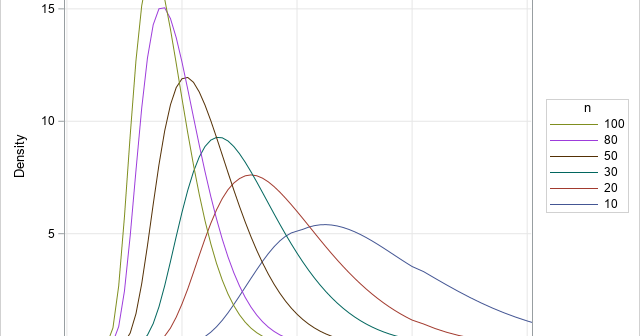

If you have ever run a Kolmogorov-Smirnov test for normality, you have encountered the Kolmogorov D statistic. The Kolmogorov D statistic is used to assess whether a random sample was drawn from a specified distribution. Although it is frequently used to test for normality, the statistic is "distribution free" in
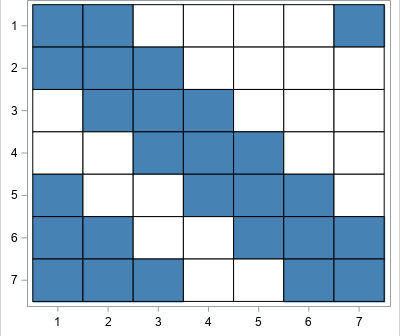
Sometimes in matrix computations, it is important to display the nonzero elements of a matrix. This can be useful for visualizing the structure of a sparse matrix (one that has many zeros) and it is also useful when describing a matrix algorithm (such as Gaussian elimination) that introduces zeros at
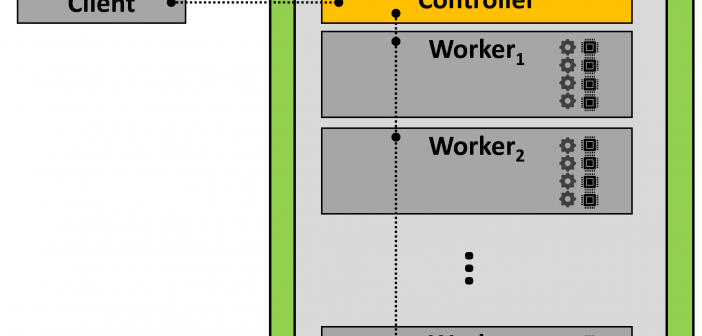
A previous article shows how to use the iml action to read a CAS data table into an IML matrix. This article shows how to write a CAS table from data in an IML matrix. You can read an overview of the iml action, which was introduced in SAS Viya