The release of the 2025-2030 Dietary Guidelines for Americans has brought both updates and conversation. As a dietitian, I’ll break down the key updates, explore why they matter, and discuss how you can build balanced, sustainable eating patterns that support your health and well-being.
What are the Dietary Guidelines for Americans?
The Dietary Guidelines for Americans (DGA) are science-backed, federal recommendations, updated every 5 years, that outline healthy eating patterns across the lifespan. They are jointly published by the U.S. Department of Agriculture (USDA) and the Department of Health and Human Services (HHS).
Each edition is developed through a multi-step, evidence-based process. A publicly nominated panel of experts – the Dietary Guidelines Advisory Committee (DGAC) – reviews the latest nutrition science through a rigorous, transparent process that takes about two years to complete.
After completing their review, the DGAC releases a Scientific Report that is open for public comment. USDA and HHS then take that report into consideration as they draft and finalize the official DGA.
Although the DGA are written primarily for policymakers and health professionals, they are also adapted for consumer-friendly tools and serve as the foundation for federal food assistance programs – including school meals and Women, Infants and Children (WIC) – meaning they directly influence at least 1 in 4 Americans.
What happened with this edition?
The development of this edition began the same way as it has for decades, with a thorough review of the latest scientific evidence by the DGAC. However, the final guidelines diverged from the committee’s recommendations more than in previous cycles. Several key DGAC conclusions – particularly around protein, saturated fats and processed foods – were not incorporated.
This unprecedented large gap between the scientific report and the final policy document has raised concern. Many have noted that the final DGA reflect more bias and influence from political and industry pressures. While the guidelines are still grounded in evidence, the degree of selective adoption has sparked significant debate about transparency and scientific integrity.
The food pyramid is back – sort of. Here’s what the new dietary guidelines say and what they really mean for your everyday meals. #eatrealfood #saslife Share on XWhat changed in the 2025-2030 Dietary Guidelines for Americans?
A lot! The 2025-2030 DGA represent the most significant overhaul in decades, with notable shifts in recommendations and visual tools. The central message is clear (and as a dietitian one I can fully stand behind): eat real food. But some of the specifics are a bit murky.
Core Recommendations
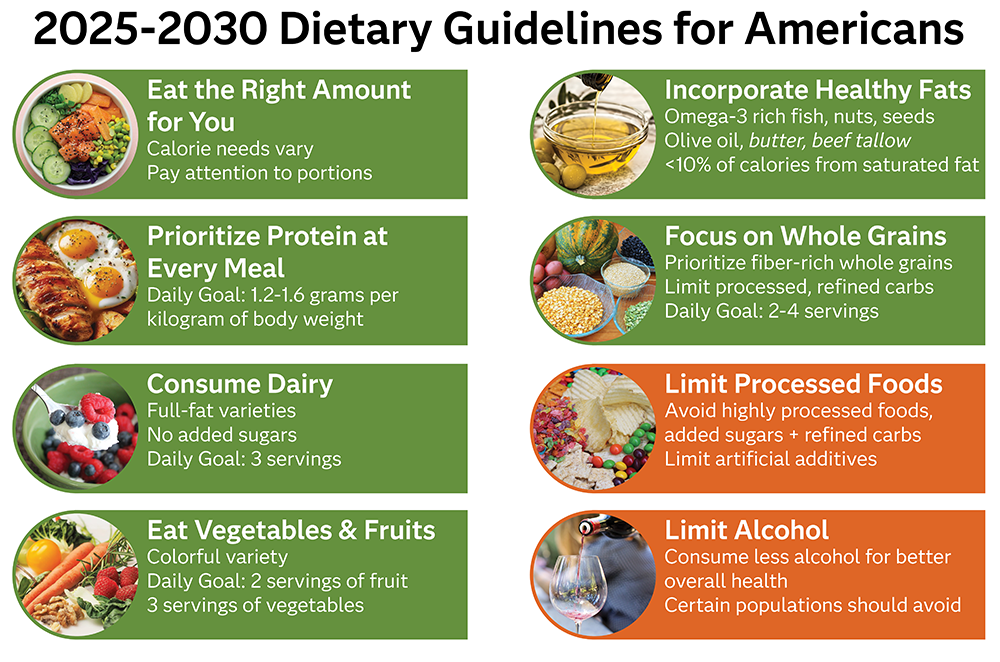
The guidelines outline eight core recommendations that are meant to shape healthy eating patterns. I’m not going to break down all eight in this blog, but I do want to highlight a few areas that created confusion, raised questions or didn’t fully align with what I see in practice as a dietitian.
Protein
Per the new guidelines, “Every meal must prioritize high-quality, nutrient-dense protein from both animal and plant sources, paired with healthy fats from whole foods such as eggs, seafood, meats, full-fat dairy, nuts, seeds, olives and avocados.”
The guidelines also introduce a significantly higher daily protein target of 1.2-1.6 grams of protein per kilogram of body weight (or 0.55-0.73 grams/pound), a notable increase from the long-standing recommendation of 0.8g/kg. There is not full consensus yet on this higher range, but it reflects growing evidence supporting increased protein needs.
Protein is essential for building and maintaining muscle, promoting satiety and supporting metabolism, so as a dietitian, I appreciate this shift and the higher daily protein targets – especially with the emphasis on quality protein sources.
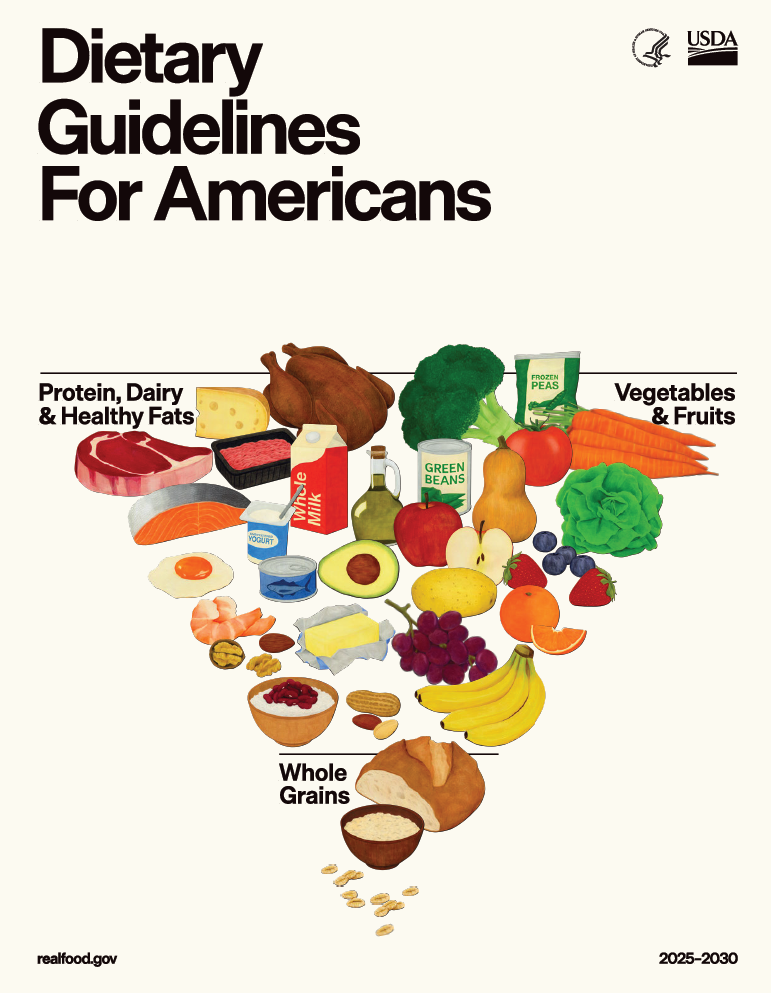
However, the visual prominence of red meat and full-fat dairy in the new pyramid is concerning. While these foods can absolutely fit into a balanced diet, the graphic does not reflect the broader evidence supporting a mix of animal and plant-based proteins. A more balanced visual would help reinforce that variety and quality matter just as much as total intake.
I’m also watching how this “protein push” is influencing food manufacturing. Grocery stores are filling up with “high protein” products, many of which are highly processed. Simply adding protein to a product doesn’t make it a nutrient-dense choice. Quality matters and whole-food protein sources will always be your best bet.
Dairy
The DGA have long included dairy products as part of a balanced diet, but the updated guidelines go a step further recommending 3 servings of full-fat dairy each day – a shift away from the previous emphasis on low-fat or fat-free options.
Now, I’m not opposed to dairy, or even full-fat dairy, but it needs to be considered in the context of an individual’s overall eating patterns, nutrient needs, and health goals. And importantly, dairy is not required for good health. Plenty of people cannot or choose not to consume dairy, and that’s completely fine. Nutrients like calcium, vitamin D, and protein can be obtained from a variety of other foods without compromising overall nutrition.

Vegetables & Fruits
Eating a variety of colorful, nutrient-dense vegetables and fruits supports nearly every aspect of health, which is why they sit prominently on the updated food pyramid alongside protein. However, the guidelines recommend just 3 servings of vegetables and 2 servings of fruit each day, but most nutrition research points toward aiming higher with at least 8-10 servings daily (with the majority coming from non-starchy vegetables).
8-10 servings can feel intimidating at first, but it’s more achievable when you build up gradually. Adding just one extra serving of vegetables – a handful of greens, a side salad, chopped veggies in a sauce – can make a meaningful difference.
To support balanced blood sugar and overall dietary variety, keep fruit intake to 2 servings per day (3 at most).
Healthy Fats
Dietary fats often get a bad rap, but they are essential for hormone production, nutrient absorption, cell membrane structure and much more. The goal is not to avoid fats, it’s to choose the right types of fats in amounts appropriate for your body.
The current DGA continue to recommend keeping saturated fat below 10% of total daily calories. At the same time, the guidelines suggest prioritizing “oils with essential fatty acids such as olive oil” while also listing butter and beef tallow as options. This is where messaging becomes inconsistent.
- If someone is consuming three servings of full-fat dairy, plus red meat, plus butter or beef tallow, staying under that saturated fat limit becomes extremely difficult.
- Butter and beef tallow also do not contain essential fatty acids, whereas foods like olive oil, salmon, walnuts and flaxseed do.
A simpler, more practical approach is to focus on consuming a variety of minimally processed, nutrient-dense fats such as avocado, olives, cold-water fish, and raw nuts and seeds.
Alcohol
Moderation is key when it comes to alcohol. If you don’t currently drink, there is no reason to start – the risks generally outweigh any potential benefits. The updated guidelines reflect this with the broad recommendation to “consume less alcohol for better overall health.”
A concern with this new guideline is the lack of specific limits. Previous editions advised no more than one drink per day for women and two for men. While those amounts were likely higher than what’s considered low risk for most people, they at least provided clear boundaries. Without those guardrails, the message becomes more ambiguous, and people may interpret “consume less” relative to their own habits rather than an evidence-based threshold.
At the same time, this shift does align with growing research that no amount of alcohol is truly risk-free, especially in respect to cardiovascular health and cancer risk.
Food Pyramid
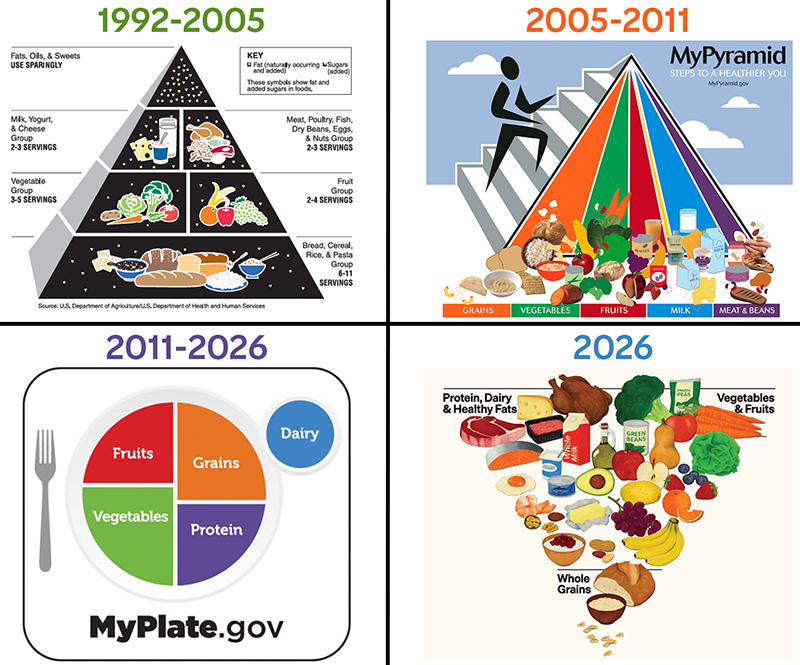
After a 15-year run, MyPlate has been retired and the famous triangle – beloved by some, criticized by many – is back. But this time, it’s flipped.
The original food pyramid used its base to represent foods that should make up the largest share of your diet, while the second iteration shifted to vertical bands to illustrate proportional intake. The newest version turns the original structure upside down, placing protein, dairy, healthy fats, vegetables and fruits at the base.
This inversion signals a shift in what the DGA consider foundational foods, and it has sparked plenty of questions about what the new base actually represents.
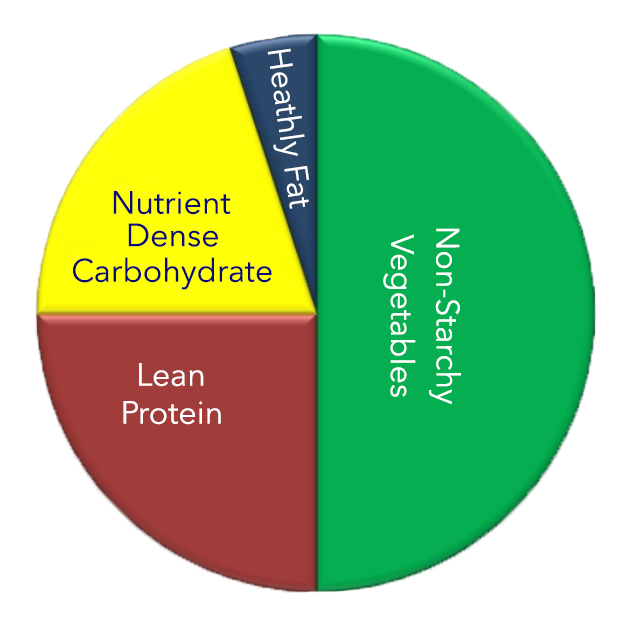
As a dietitian, I’ve never been a big fan of pyramid-style visuals. They tend to be confusing, overly generalized and difficult to translate into real-life eating habits. MyPlate came the closest, offering a more practical, plate-based guide – but even then, there were elements that didn’t fully align with what we see in practice.
That’s why my team uses a modified version that more accurately reflects macronutrient balance and nutrient needs. It’s designed as a flexible blueprint – something you can adjust in portions, proportions and food choices to meet your individual needs and preferences.
Key Takeaways
If you set aside the controversies and mixed messages within the 2025-2030 Dietary Guidelines for Americans, the central message remains simple and powerful: eat real food.
A balanced, nutrient-dense eating pattern matters way more than any single recommendation.
Prioritizing a variety of whole foods – especially vegetables, high-quality proteins, whole grains, and healthy fats – continues to be the most reliable path toward better health, regardless of how the guidelines evolve.
Buffalo Chicken Salad
Makes 4 servings
PRINT RECIPE

Ingredients
1lb chicken, cooked and shredded (or 4 cups shredded rotisserie chicken)
1 cup cottage cheese
½ cup chopped celery
¼ cup buffalo sauce, or to taste
1 tsp garlic powder
1 tsp paprika
salt and pepper, to taste
Directions
- Add everything to a large bowl and mix well until combined.
- Serve over a bed of lettuce, in a wrap, or with whole grain crackers.