All Posts
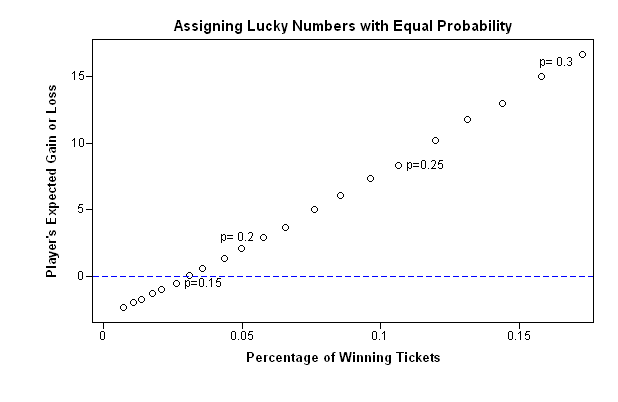

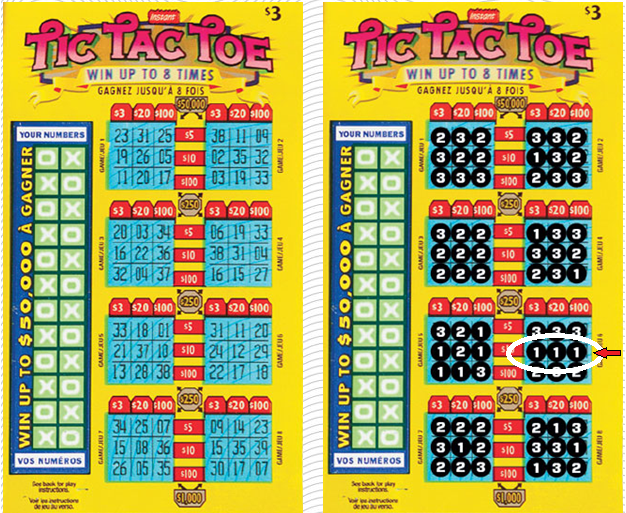
Because of this week's story about a geostatistician, Mohan Srivastava, who figured out how predict winning tickets in a scratch-off lottery, I've been thinking about scratch-off games. He discovered how to predict winners when he began to "wonder how they make these [games]." Each ticket has a set of "lucky
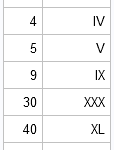
I enjoyed the Dataists' data-driven blog on the best numbers to choose in a Super Bowl betting pool. It reminded me of my recent investigation of which initials are most common. Because the Dataists' blog featured an R function that converts Arabic numerals into Roman numerals, the blog post also
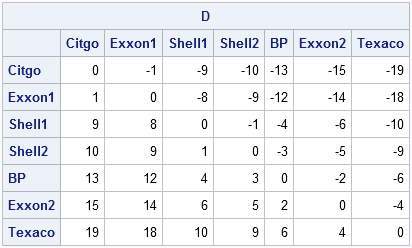
The other day, someone asked me how to compute a matrix of pairwise differences for a vector of values. The person asking the question was using SQL to do the computation for 2,000 data points, and it was taking many hours to compute the pairwise differences. He asked if SAS/IML
On Friday, I posted an article about using spatial statistics to detect whether a pattern of points is truly random. That day, one of my colleagues asked me whether there are any practical applications of detecting spatial randomness or non-randomness. "Oh, sure," I replied, and rattled off a list of
When you pass a matrix as an parameter (argument) to a SAS/IML module, the SAS/IML language does not create a copy of the matrix. That approach, known as "calling by value," is inefficient. It is well-known that languages that implement call-by-value semantics suffer performance penalties. In the SAS/IML language, matrices


Millions of Americans will be gathering around the television this Sunday to watch Super Bowl XLV. They'll gather in bars and private homes, prepare billions of calories worth of snacks, and root for their favorite teams. But if you're looking for an alternate form of entertainment, why not watch "New
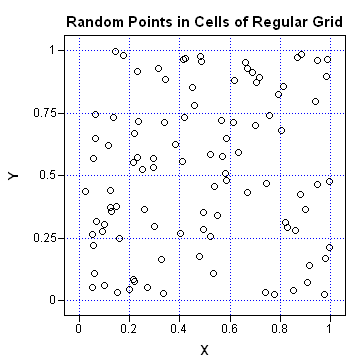
Last week I generated two kinds of random point patterns: one from the uniform distribution on a two-dimensional rectangle, the other by jittering a regular grid by a small amount. My show choir director liked the second method (jittering) better because of the way it looks on stage: there are
One of my New Year's resolutions is to learn a new area of statistics. I'm off to a good start, because I recently investigated an issue which started me thinking about spatial statistics—a branch of statistics that I have never formally studied. During the investigation, I asked myself: Given an

As Cat Truxillo points out in her recent blog post, some SAS procedures require data to be in a "long" (as opposed to "wide") format. Cat uses a DATA step to convert the data from wide to long format. Although there is nothing wrong with this approach, I prefer to
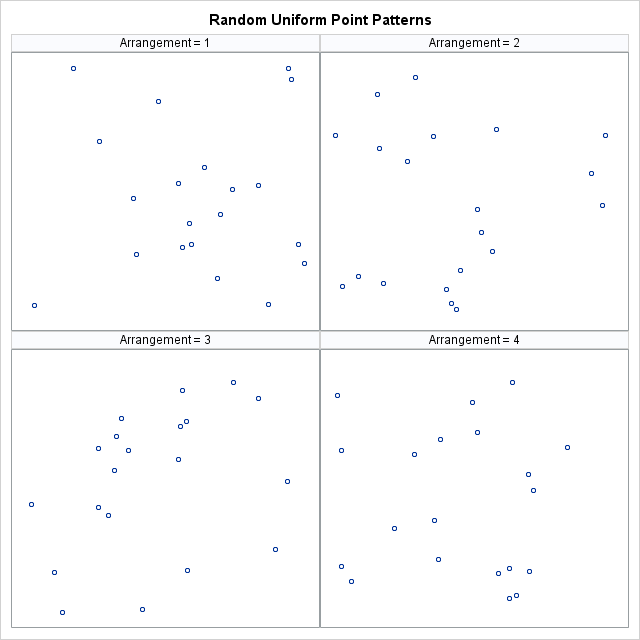
I sing in the SAS-sponsored VocalMotion show choir. It's like an adult version of Glee, except we have more pregnancies and fewer slushie attacks. For many musical numbers, the choreographer arranges the 20 performers on stage in an orderly manner, such as four rows of five singers. But every once


I have recently had the great opportunity to be a part of a very special project called the North Carolina Bio-Preparedness Collaborative (NCB-Prepared) It is a public-private partnership that includes the University of North Carolina at Chapel Hill (UNC), North Carolina State University, and SAS, with support from the US
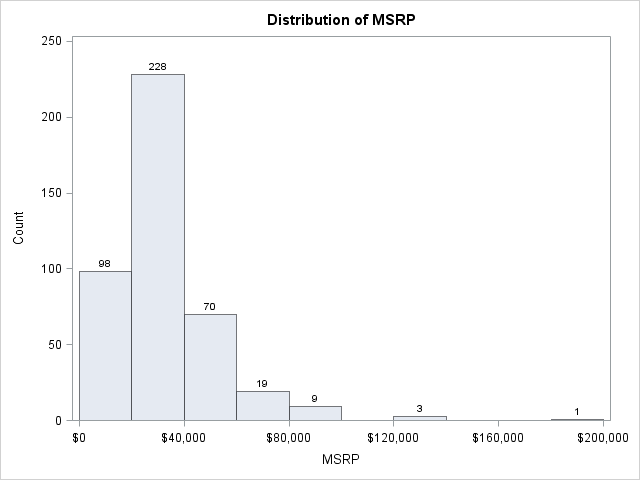
A histogram displays the number of points that fall into a specified set of bins. This blog post shows how to efficiently compute a SAS/IML vector that contains those counts. I stress the word "efficiently" because, as is often the case, a SAS/IML programmer has a variety of ways to

Have you ever wanted to compute the exact value of a really big number such as 200! = 200*199*...*2*1? You can do it—if you're willing to put forth some programming effort. This blog post shows you how. Jiangtang Hu's recent blog discusses his quest to compute large factorials in many programming languages.


Who doesn’t like bargains? I’m sure you will all agree that good quality at a next-to-nothing cost is irresistible. My recent Dollarama run had me ecstatic about the gloves that come in all colours, styles and sizes for just over a dollar. (Fact: big retail stores charge over 10 times
The other day I needed to check that a sequence of numerical values was in strictly increasing order. My first thought was to sort the values and compare the sorted and original values, but I quickly discarded that approach because it does not detect duplicate values in a montonic (nondecreasing)