Tag: Getting Started

Rick Wicklin 0
The UNIQUE-LOC trick: A real treat!

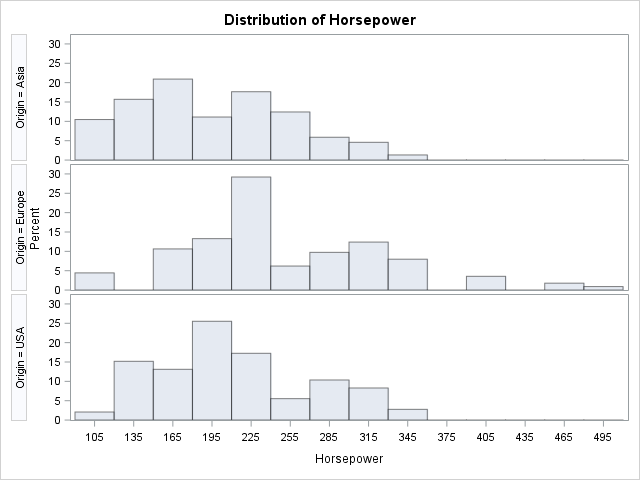
When you analyze data, you will occasionally have to deal with categorical variables. The typical situation is that you want to repeat an analysis or computation for each level (category) of a categorical variable. For example, you might want to analyze males separately from females. Unlike most other SAS procedures,

Rick Wicklin 0
Four essential functions for statistical programmers

Normal, Poisson, exponential—these and other "named" distributions are used daily by statisticians for modeling and analysis. There are four operations that are used often when you work with statistical distributions. In SAS software, the operations are available by using the following four functions, which are essential for every statistical programmer

Rick Wicklin 0
Does SYMPUT work in IML?

I received the following email: Dear Dr. Wicklin, Why doesn't SYMPUT work in IML? In the DATA step, I can say CALL SYMPUT("MyMacro", 5) but this doesn't work in IML! Frustrated Dear Frustrated, The SYMPUT subroutine does work in SAS/IML software! However, the second argument to SYMPUT must be a

Rick Wicklin 0
Storing and loading modules

You can extend the capability of the SAS/IML language by writing modules. A module is a user-defined function. You can define a module by using the START and FINISH statements. Many people, including myself, define modules at the top of the SAS/IML program in which they are used. You can

Rick Wicklin 0
Complex assignment statements: CHOOSE wisely

This article describes the SAS/IML CHOOSE function: how it works, how it doesn't work, and how to use it to make your SAS/IML programs more compact. In particular, the CHOOSE function has a potential "gotcha!" that you need to understand if you want your program to perform as expected. What

Rick Wicklin 0
Options for Printing a Matrix

A matrix is an array of numbers or character strings. When I print a matrix, I usually want to see only the data. However, sometimes it is helpful to add row or column headings that indicate the names of variables or labels for rows. A simple example is count data

Rick Wicklin 0
A simple signum function

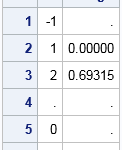
The other day I needed to compute the signum function for each element of a matrix. If x is a real number, then the sgn(x) is -1 when x<0, 1 when x>0, and 0 when x=0. I wrote a SAS/IML module that contains a compact little expression: proc iml; start

Rick Wicklin 0
An easy way to specify dates and times

Dates and times. As Wayne Finley states in his SUGI25 paper on SAS date and time handling, "The SAS system provides a plethora of methods to handle date and time values." Along with the plethora of methods is a plethora of papers on the topic. If you want to trick

Rick Wicklin 0
Pre-allocate arrays to improve efficiency

Recently Charlie Huang showed how to use the SAS/IML language to compute an exponentially weighted moving average of some financial data. In the commentary to his analysis, he said: I found that if a matrix or a vector is declared with specified size before the computation step, the program’s efficiency

Rick Wicklin 0
Use subscript reduction operators!

Writing efficient SAS/IML programs is very important. One aspect to efficient SAS/IML programming is to avoid unnecessary DO loops. In my book, Statistical Programming with SAS/IML Software, I wrote (p. 80): One way to avoid writing unnecessary loops is to take full advantage of the subscript reduction operators for matrices.

Rick Wicklin 0
Listing SAS/IML variables

Did you know that you can display a list of all the SAS/IML variables (matrices) that are defined in the current session? The SHOW statement performs this useful task. For example, the following statements define three matrices: proc iml; fruit = {"apple", "banana", "pear"}; k = 1:3; x = j(1E5,

Rick Wicklin 0
Variable transformations

One of the advantages of programming in the SAS/IML language is its ability to transform data vectors with a single statement. For example, in data analysis, the log and square-root functions are often used to transform data so that the transformed data have approximate normality. The following SAS/IML statements create

1 5 6 7 8