If Day 1 asked what organizations should scale with AI, Day 2 showed what that looks like when trusted technology, industry expertise and human judgment come together in the moments that matter.
Day 2 of SAS Innovate 2026 moved quickly from vision to application. Across banking, health care and life sciences, public sector and sports, SAS leaders, customers and partners demonstrated how AI delivers value when it is grounded in real industry workflows and designed to support decisions that carry real consequences. The message across sessions was consistent: in high-stakes environments, ideally, AI has to help people make better decisions with confidence.
Recognizing the SAS Hackathon winners driving real-world innovation
The session opened with the SAS Hackathon, highlighting how new ideas move from concept to impact. SAS Hackathon Global Program Managers, Einar Halvorsen and Peter Lundqvist, reflected on the program’s five global editions, which now bring together participants from business, government and academia to tackle real‑world challenges using SAS® Viya®.
The 2025 competition drew more than 2,000 applicants from 66 countries, forming 125 teams representing more than 150 organizations. Many of the projects addressed challenges from insurance recovery following catastrophic flooding to more efficient, lower‑energy telecom forecasting.
DementAI was crowned the 2025 SAS Hackathon Grand Champion for its solution focused on earlier detection of Alzheimer’s disease. By combining EEG data, health records and unstructured medical data with machine learning and agentic AI, the team's work could help clinicians intervene sooner. It’s a clear example of what happens when these ideas move beyond experimentation and into real clinical impact.
Celebrating customer excellence across generations
As part of SAS’ 50th anniversary, the session also recognized customers whose work reflects that philosophy through the introduction of the Jim Goodnight Excellence Awards. The awards unify decades of SAS customer recognition, reaching back to the company’s earliest user group conferences.
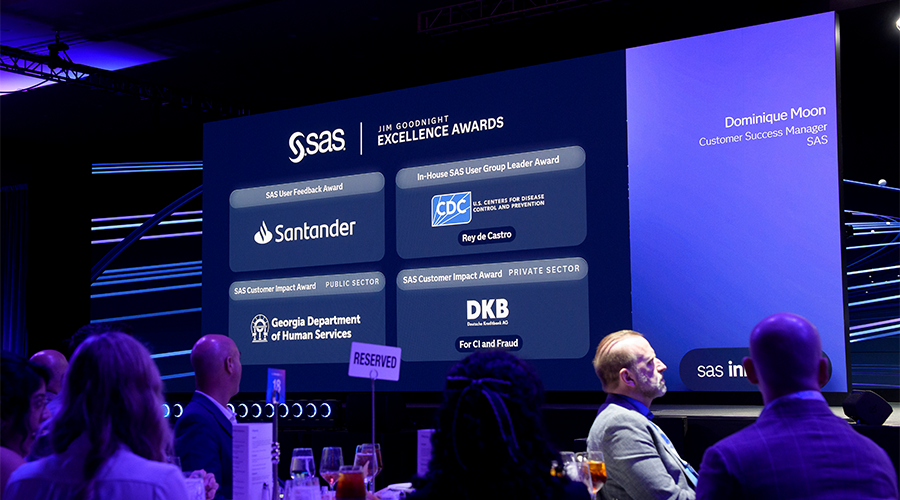
More than a milestone moment, the recognition reinforced a long‑standing SAS belief: innovation is defined not by technology alone, but by how organizations apply analytics and AI to create meaningful, responsible impact. The Jim Goodnight Excellence Awards honor customers who are doing exactly that across industries and communities.
Progress starts with people
Tom Roehm, SAS VP of Corporate Marketing, then set the transition from innovation to industry application by reinforcing a core theme of SAS Innovate: progress does not begin with technology. It begins with people making decisions in environments where trust matters and being “mostly right” is not enough.
That perspective became the foundation for the industry examples that followed.
Banking: Every decision is a moment of trust
The first industry spotlight focused on banking, where Stu Bradley, SAS SVP of Risk, Fraud and Compliance and Udo Sglavo, SAS VP of Applied AI and Modeling, addressed the pressure financial institutions face to move faster while meeting regulatory obligations and protecting customers. In banking, every transaction and alert shapes trust.
SAS supports more than 300 billion decisions annually, Bradley said, helping save over $500 million in fraud-related losses. Sglavo added that SAS industry‑ready models have been proven across 32 billion real‑world transaction decisions in the United States. At that scale, the tradeoff between protection and customer experience starts to disappear.
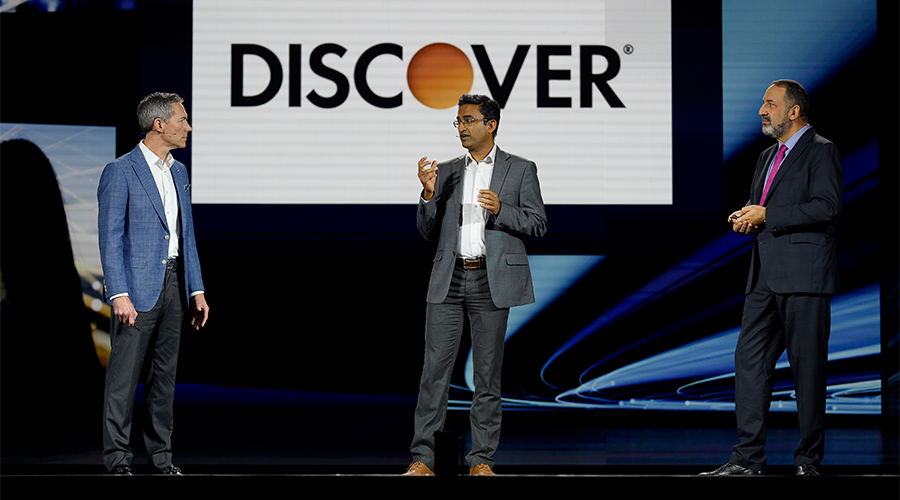
That perspective was reinforced by customer insights from Dinesh Jayaraman, Discover's Director of Enterprise Fraud Decisioning. Jayaraman explained that integrating fraud and risk decisioning helps deliver more consistent customer experiences while reducing internal complexity. He also emphasized explainability as essential, noting that a unified decisioning framework makes it easier to understand, defend and refine decisions across teams.
The conversation then expanded into customer engagement, where SAS® Customer Intelligence 360 demonstrated how agentic AI can assist marketers by translating a campaign brief into a proposed audience and journey strategy. The point wasn’t automation for its own sake. AI handles the setup work while humans retain control over the decisions.
Health care and life sciences: Faster decisions, better outcomes
From financial services, the session shifted to health care and life sciences. Bradley and Sglavo highlighted an industry under constant pressure to accelerate discovery, streamline operations and keep patients at the center of every decision.
Fortune 500 pharmaceutical companies rely on SAS not only for analytics but also for the ability to design more accessible, patient‑centric clinical trials. That point came to life through a customer example from Dompé, which shared how SAS Viya helps shorten the path from prototype models to production deployment. The result is faster decision‑making and more immediate impact for research teams.
Supply chain planning is a challenge best described as decision friction rather than data scarcity, according to Sglavo. To illustrate that shift, he showcased a sales and operations planning scenario using the SAS Supply Chain Agent. The agent evaluated production plans, identified service‑level risks, ran scenarios and surfaced tradeoffs in real time, helping teams move from reporting information to making informed decisions inside the flow of work.
Public sector: Protecting program integrity and public trust
Next, the session turned to the public sector, where decision quality directly affects public trust. Bradley highlighted SNAP, which supports more than 40 million people in the United States each month. In that context, payment integrity helps ensure benefits reach eligible recipients while safeguarding taxpayer dollars.
Sglavo, in an interview with an official from the Georgia Department of Human Services, described how SAS payment integrity models help agencies focus investigative resources more effectively. The official shared the impact that's having on the state of Georgia and how investigation timelines are now cut in half, with further reductions ahead. Importantly, the official emphasized that AI supports decision‑makers rather than replacing them.
Bradley followed with another example from the North Carolina Department of Revenue, which enhanced an identity theft refund fraud program using SAS AI. By integrating data across agencies, the department achieved more than $900 million in refund savings in a single year.
Sports: Personalizing fan engagement at a global scale
The final industry spotlight brought a jolt of energy with the announcement of an expanded partnership between SAS and Liverpool Football Club. Using SAS Customer Intelligence 360 and SAS Viya, Liverpool FC aims to deliver more personalized, real‑time digital fan experiences and advance toward adaptive engagement powered by AI agents.
Liverpool FC VP of Marketing Chris Jennions joined SAS Sr. Director of Customer Intelligence Solutions Kate Parker on stage to explain how SAS stood out for its pace of innovation and collaborative approach. He described the club as a global business encompassing ecommerce, ticketing, tours and partnerships, all of which must work together to support growth.
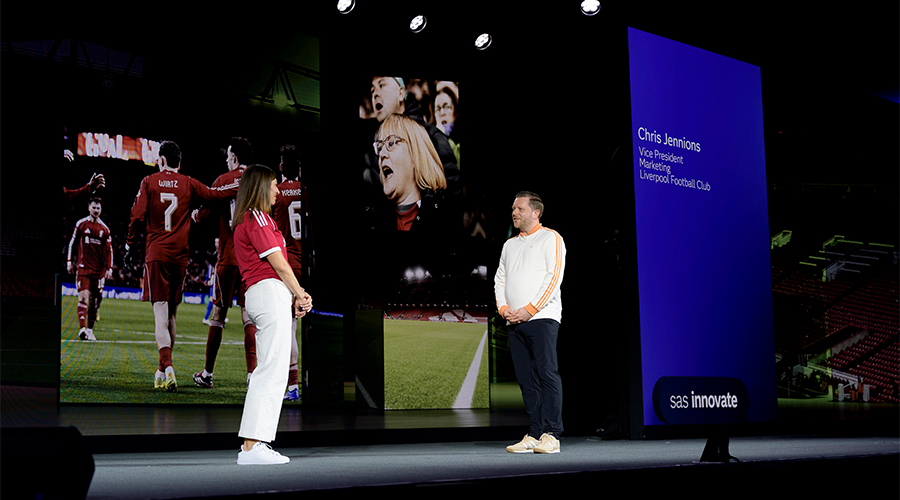
For supporters, the goal is more relevant, timely engagement. For SAS, the partnership illustrated how trusted data and AI can strengthen relationships at scale without losing sight of the human connection.
One goal across industries
By the session’s close, the pattern was unmistakable. Banking scenarios showed fraud prevention improving alongside customer experience. Life sciences examples walked through faster paths from discovery to delivery. Government use cases demonstrated how agencies protect citizens and public funds. Customer intelligence demos highlighted how global brands deliver more relevant, timely engagement.
Different industries, different pressures, one shared objective: better decisions where the outcomes matter most.