
Generative AI showed up in the enterprise fast.
In what felt like no time, it went from something people were experimenting with to something leaders were expected to have a plan for. Not just whether to adopt it, but how it fits into the future of their organization.
Underneath all the momentum, companies are starting to realize the hard part isn’t deploying AI – it’s figuring out where it actually belongs, what it can be trusted to do and what changes when decision-making itself starts to scale.
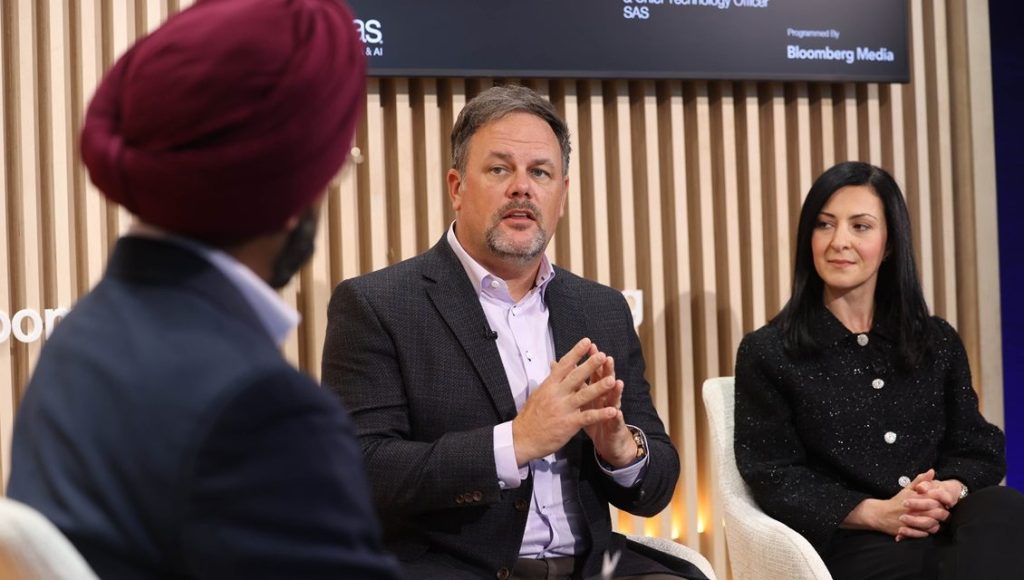
At a recent Bloomberg panel discussion during the World Economic Forum in Davos, SAS CTO Bryan Harris offered his perspective on this trending topic.
The real problem AI is solving
Right now, AI conversations tend to sound like a competition. Better models. Faster answers. Improved outcomes. Truth is, organizations are overwhelmed by data.
“We’ve got this information overload scenario that’s constant, which means organizations are generating exponentially more data every day with no end in sight,” Harris said. “And the capacity to consume and make sense of this information is limited by the number of people in a company to process it.”
AI, in this sense, is less about automation and more about amplification – expanding people and organizations' ability to close the widening information-processing gap. Generative and agentic AI represent an important step forward, but only when applied with intention. Not every problem should be solved with AI.
The future, Harris suggested, belongs to organizations that are deliberate about how they apply AI to solve a business problem.
Watch Bryan Harris' full remarks in this video
Trust in AI starts with people
A lot of the trust conversation around AI focuses on technical issues like hallucinations, accuracy and governance. Harris pointed to something more basic: trust in AI starts with trust inside an organization.
“I would argue that the first step in increasing trust with AI is increasing the trust between leaders and their workforce,” Harris said.
He expanded on this, saying leaders should invest in people and their careers rather than displacing them with AI.
“When employees see AI as a replacement, adoption slows,” Harris said. "When they see AI as a tool to help them work better, behavior changes. The nature of work shifts as well. Historically, analysts and data scientists have spent 80% of their time preparing data and only 20% interpreting it. AI introduces the possibility of reversing that balance.”
In other words, AI doesn’t remove human judgment. It makes it more important.
I would argue that the first step in increasing trust with AI is increasing the trust between leaders and their workforce. Bryan Harris
One AI system won’t solve everything
If there is a misconception shaping the current AI narrative, it’s the idea that a single model can handle every task. Harris pushed back on that idea, especially in highly regulated industries like banking and life sciences, where decisions carry real consequences.
“These decisions can’t just be 95% accurate. They have to be 100% accurate every time.”
In reality, enterprise AI is starting to look less like a single system and more like an ecosystem. Generative AI makes interaction easier and lowers the barrier to entry. Predictive models and rules-based systems provide consistency and explainability. Decisioning frameworks connect everything together.
AI changes how organizations build
Some of the most immediate impacts of AI are happening behind the scenes. Harris described how coding agents are already reshaping development cycles and compressing timelines that once stretched for months.
“We’re now seeing timelines reduced from two months down to one week or a few days.”
But speed isn’t the only benefit. The bigger shift is how organizations reuse knowledge. Design systems, governance standards and architecture that once lived as documentation are becoming active inputs for AI systems – a context that helps teams build consistently, at scale.
AI, in this sense, compounds previous investments. The better structured an organization’s knowledge is, the more valuable it becomes over time.
Investing in people
As the conversation wrapped up, Harris returned to a theme that has outlasted every hype cycle: technology will always change.
“The current mode of AI, generative AI, is one iteration of the next 50.”
What remains the same is how organizations must respond to that change.
“Invest in people. That is a tried-and-true strategy.”
Moving past the hype
The AI conversation often focuses on capability. Harris’ perspective reframes it as a responsibility.
AI is not simply another tool to deploy. It is a shift in how decisions are made, validated and trusted. Organizations that recognize this early will invest in people who build systems that are deliberate and realistic about where AI belongs.