
I explored the potential of agentic AI across four foundational insurance functions in a previous blog article. Building on that discussion, this article takes a focused look at one of those pivotal functions – claims processing.
Global insurance companies are intensively exploring which practical applications of agentic AI can deliver the most impact to their business. With the search underway, many pilot projects and implementations have started with a focus on claims processing or fraud management functions.
These functions are ripe for change through digital transformation as insurers look to boost efficiency, reduce risks and deliver superior service. According to a recent survey of more than 350 global insurance executives, claims management and operational strategy are top priority areas for investment in AI and machine learning.
Insurers that incorporate the latest advancements in autonomous AI technologies across functional areas stand to benefit most.
Read the other blogs in this series about agentic AI in insurance
What makes claims processing the heart of insurance?
Claims processing is a critical customer touchpoint for all insurance companies. Ideally, it should be intertwined with other core business functions, including customer acquisition, pricing and underwriting.
The problem of insurance silos
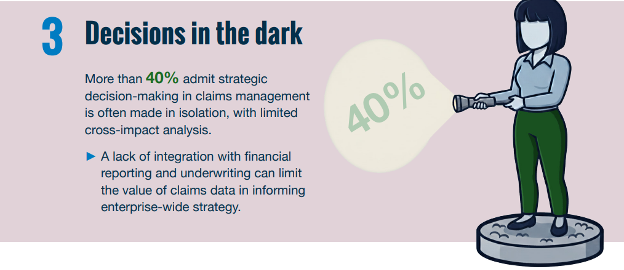
Decisions made by actuarial and underwriting, claims, finance and technology teams are interdependent. A misstep in one area can cascade into unexpected consequences elsewhere. For instance, underwriting depends on claims data and actuarial insights to inform risk acceptance and pricing decisions. Any imbalance can create increased frequency or severity of claims, directly impacting the combined ratio and eroding capital.”
Download report – Breaking silos: Agile insurance in an uncertain world
The claims journey typically happens in five stages, encompassing all the steps taken to evaluate, validate and ultimately pay out policyholder claims.
- Claim intake – receiving and logging the claim.
- Triage – assessing the urgency and severity of the claim.
- Investigation – gathering information related to the claim and verifying each of the details.
- Adjudication – determining coverage and liability.
- Settlement – calculating and issuing payments.
Each step requires coordination among various departments and external parties, as well as data analysis and timely communication (both internally and externally). These factors are crucial in shaping the quality of customer service and experience, not to mention the efficiency of internal operations. Improvement in these areas is where agentic AI can provide significant value.
How does agentic AI supercharge the claims journey?
Agentic AI technologies are poised to revolutionize nearly every aspect of claims processing. This includes:
Intelligent intake
AI agents can automatically capture and extract information from digital forms, emails or even spoken claims, substantially reducing manual data entry and speeding the initial claim setup.
Dynamic triage
Through real-time data analysis, agentic AI can prioritize claims based on complexity, risk and urgency, ensuring that each case is routed to the most appropriate handler. In simple cases, an AI agent could be allowed to resolve claims instantly (on its own).
Streamlined investigation
AI agents can quickly collect and cross-reference data from various sources, such as police reports, medical records and weather information. Simultaneously, they can scan for fraud indicators and inconsistencies that might be missed by human processors.
While claims managers have rich knowledge and experience, AI agents can rapidly see patterns based on all the claims data used to train the models they rely on. The training data could extend to decades of claims history. This expanded view could uncover correlations that would have remained hidden from human processors.
Automated adjudication – and automated settlements
For straightforward claims, agentic AI can evaluate policy coverage, calculate accurate payouts and initiate payments, all without human intervention. This can dramatically reduce processing times. And because AI agents continuously learn from the results of all previous claims processes (i.e., results are incorporated into training models), their accuracy continually increases. Likewise, error rates drop.
Unlocking efficiency: The tangible benefits of agentic AI
By deploying agentic AI across the claims life cycle, insurers can expect notable improvements.
- Faster turnaround. Claims progress more quickly, improving customer satisfaction and reducing backlogs.
- Greater consistency and accuracy. Standardized AI-driven decisions minimize errors and enhance predictability.
- Lower costs. Automation frees staff to focus on complex or high-value tasks, reducing overall operational expenses.
- Proactive fraud prevention. Agentic AI detects suspicious patterns across large data sets in real time.
- AI-powered processing adapts easily to surges or drops in claim volumes without sacrificing quality.
Transforming strategic potential with agentic AI
By automating and optimizing each stage of the claims cycle, insurers can lower costs while boosting efficiency, accuracy and service excellence. But to unlock the full potential of agentic AI, insurers first need a trustworthy data foundation and clearly established governance. With this foundation in place, insurers can effectively deploy agentic AI across core functions – underwriting, claims processing, fraud detection and customer engagement.
SAS® Viya®, an end-to-end data and AI platform, enables seamless collaboration between intelligent agents across business areas. Learn more about how agentic AI, powered by the intelligent decisioning capabilities of SAS Viya, can help you deliver a more consistent and personalized experience to policyholders and drive competitive advantage.