The DO Loop
Statistical programming in SAS with an emphasis on SAS/IML programs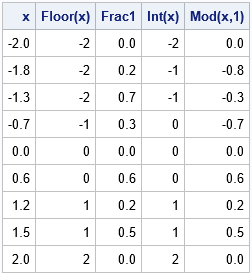

You can represent every number as a nearby integer plus a decimal. For example, 1.3 = 1 + 0.3. The integer is called the integer part of x, whereas the decimal is called the fractional part of x (or sometimes the decimal part of x). This representation is not unique.
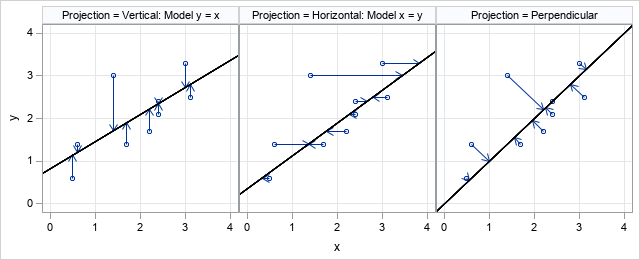
A SAS programmer wanted to create a graph that illustrates how Deming regression differs from ordinary least squares regression. The main idea is shown in the panel of graphs below. The first graph shows the geometry of least squares regression when we regress Y onto X. ("Regress Y onto X"
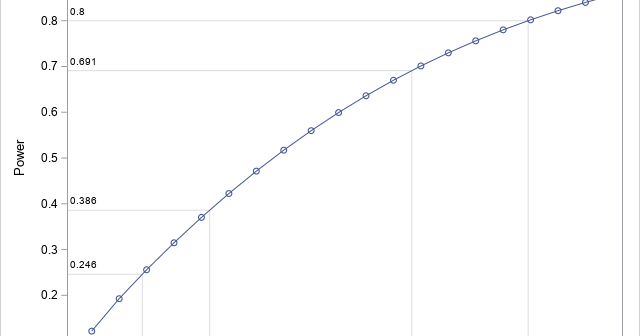
Recently someone on social media asked, "how can I compute the required sample size for a binomial test?" I assume from the question that the researcher was designing an experiment to test the proportions between two groups, such as a control group and a treatment/intervention group. They wanted to know