The DO Loop
Statistical programming in SAS with an emphasis on SAS/IML programs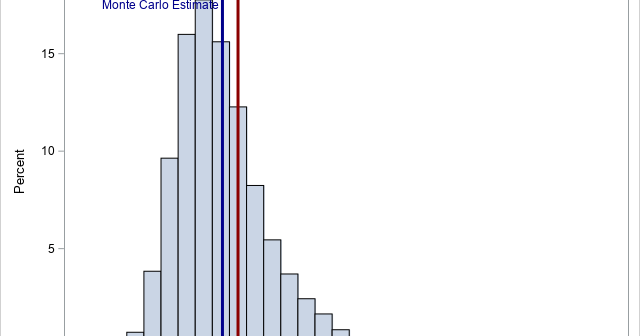

The skewness of a distribution indicates whether a distribution is symmetric or not. The Wikipedia article about skewness discusses two common definitions for the sample skewness, including the definition used by SAS. In the middle of the article, you will discover the following sentence: In general, the [estimators]are both biased
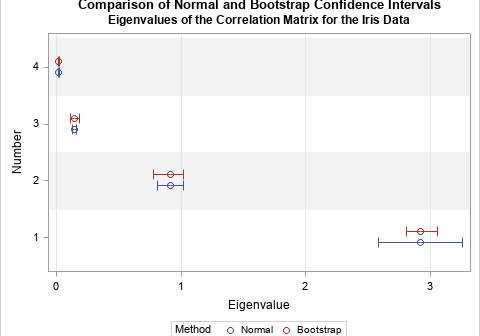
A fundamental principle of data analysis is that a statistic is an estimate of a parameter for the population. A statistic is calculated from a random sample. This leads to uncertainty in the estimate: a different random sample would have produced a different statistic. To quantify the uncertainty, SAS procedures
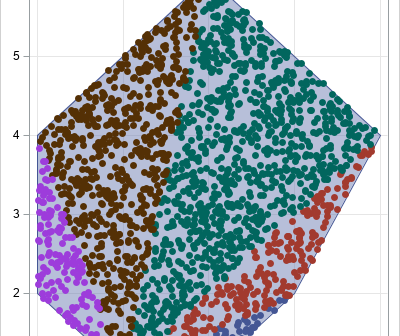
The triangulation theorem for polygons says that every simple polygon can be triangulated. In fact, if the polygon has V vertices, you can decompose it into V-2 non-overlapping triangles. In this article, a "polygon" always means a simple polygon. Also, a "random point" means one that is drawn at random