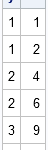
When you pass a matrix as an parameter (argument) to a SAS/IML module, the SAS/IML language does not create a copy of the matrix. That approach, known as "calling by value," is inefficient. It is well-known that languages that implement call-by-value semantics suffer performance penalties. In the SAS/IML language, matrices
Tag: Getting Started
Passing arguments by reference: An efficient choice
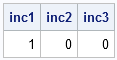
Test whether a sequence is increasing
The other day I needed to check that a sequence of numerical values was in strictly increasing order. My first thought was to sort the values and compare the sorted and original values, but I quickly discarded that approach because it does not detect duplicate values in a montonic (nondecreasing)
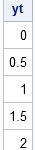
On the flip side: Exchanging rows and columns
When your data are in rows, but you need them in columns, use the matrix transpose function or operator. The same advice applies to data in columns that you want to be in rows. For example, the vectors created by the DO function and the index creation operator are row