Authors: Phoemphun Oothongsap, Lili Li, Derya Biryol, and Artin Armagan
In modern banking, fraud detection models are the silent heroes, scoring billions of transactions annually and standing as the primary shield against catastrophic financial and reputational damage. But the models protecting the institution are only as strong as the system that supports them: Model Risk Management (MRM).
Historically, MRM has been an anchor of inefficiency. Risk teams are forced into a cycle of manual, arduous work, including waiting for scheduled reports, sifting through static dashboards, and chasing down data owners for model performance updates. This slow, backward-looking approach creates dangerous reporting delays, leaving institutions vulnerable to regulatory gaps and undetected model drift.
It doesn't have to be this way. Imagine moving beyond the confines of old-school Model Risk Management. Our new approach fundamentally streamlines your compliance and review process by delivering real-time model reporting and statistical outputs, finally eliminating the delays caused by static dashboards and manual reviews.
What if we could simply ask for the answers to our MRM reporting?
With the power of Large Language Models (LLMs), MRM preparations can be shifted to a more conversational style. Instead of combing through many spreadsheets, documents, and databases, you would simply type:
- "Show me transaction volume by month and portfolio."
- "What is the monthly fraud transaction percentage?"
- "Show me the last quarter’s data drift."
Within seconds, you would receive a summary presented as clean tables and visual charts.
Another example would be typing:
- "Has the fraud model been retrained since the last validation?"
The system responds this time with a timeline, links to documentation, and a summary of changes.
This could be the future of MRM reporting: conversational, intelligent, and on-demand. A future where users can interact with MRM reports and data via a chat, instead of a static dashboard. An MRM agent would understand context, retrieve relevant report sections, and perform calculations. Thus, analysts, auditors, and regulators could query the system at any time and receive instant answers.
Why Generative AI is a game-changer for fraud detection
Fraud detection models are continually evolving to address new threats, shifts in customer behavior, and emerging technologies. To keep up, MRM needs to be equally adaptable. Here’s how conversational MRM, powered by generative AI, could revolutionize the process:
- Real-Time Transparency: Instant visibility into model lineage, validation status, and performance metrics.
- Audit-Ready Insights: Generate regulatory-compliant summary reports instantly.
- LLM-Integrated Analysis: Use LLMs to process analyst requests, written in plain English, and convert them into actions within a statistical framework.
- Dynamic Visualizations: Automatically highlight model trends and outliers as they occur with dynamic dashboards and charts.
Business use case
Transactional fraud detection models continuously monitor vast volumes of monetary and non-monetary transactions in real-time to detect anomalous behavior. These models must be continuously validated, monitored, and documented. Traditional MRM workflows often struggle to keep pace with fraud. Risk teams struggle to keep up with the following:
- Data monitoring
- Model performance evaluations
- Data drift
- Shifts in fraud patterns
- Regulatory documentation requirements
This is where an MRM AI Agent could become transformative.
Instant Data & Model Monitoring
The agent can automatically track model performance metrics, such as the fraud detection rate, false positives, and score distributions, in real-time. For example:
- "Show me the fraud detection rate by portfolio over the last quarter."
- "Show me the bi-weekly score distribution by portfolio over the last quarter."
Data Drift Detection
It can analyze distributions of input variables and detect drift over time. It could be asked:
- "Has the transaction amount distribution shifted since the first quarter?"
Conversational Access to Insights to Update Business Rules
Instead of querying various databases, teams can simply ask questions and receive visual summaries, charts, and links to documentation. Questions such as:
- "Compare fraud scores for flagged transactions last month versus this month."
- “Compare last week's score distribution to the preceding one month.”
- “Have there been any significant shifts in modeling fields of the data over the last six months?”
- “What is the transaction detection rate of the model at an alert rate of 0.5% over the last 3 months?”
Scenario Simulation & Stress Testing
The agent can simulate edge cases. Examples would be:
- “Construct a scenario in which 1% of monthly transactions exhibit high-velocity fallback behavior, where the payment system rapidly and automatically switches to an alternative transaction method. Assess the impact of this scenario on model performance.”
- "Show me the score distribution shift over a week, assuming that 50% of transactions had their amounts doubled. Summarize the impact of this change on model performance."
Audit-Ready Documentation
The agent maintains a timeline of model changes, validations, and retraining events. It could be asked:
- "Summarize model changes since last review."
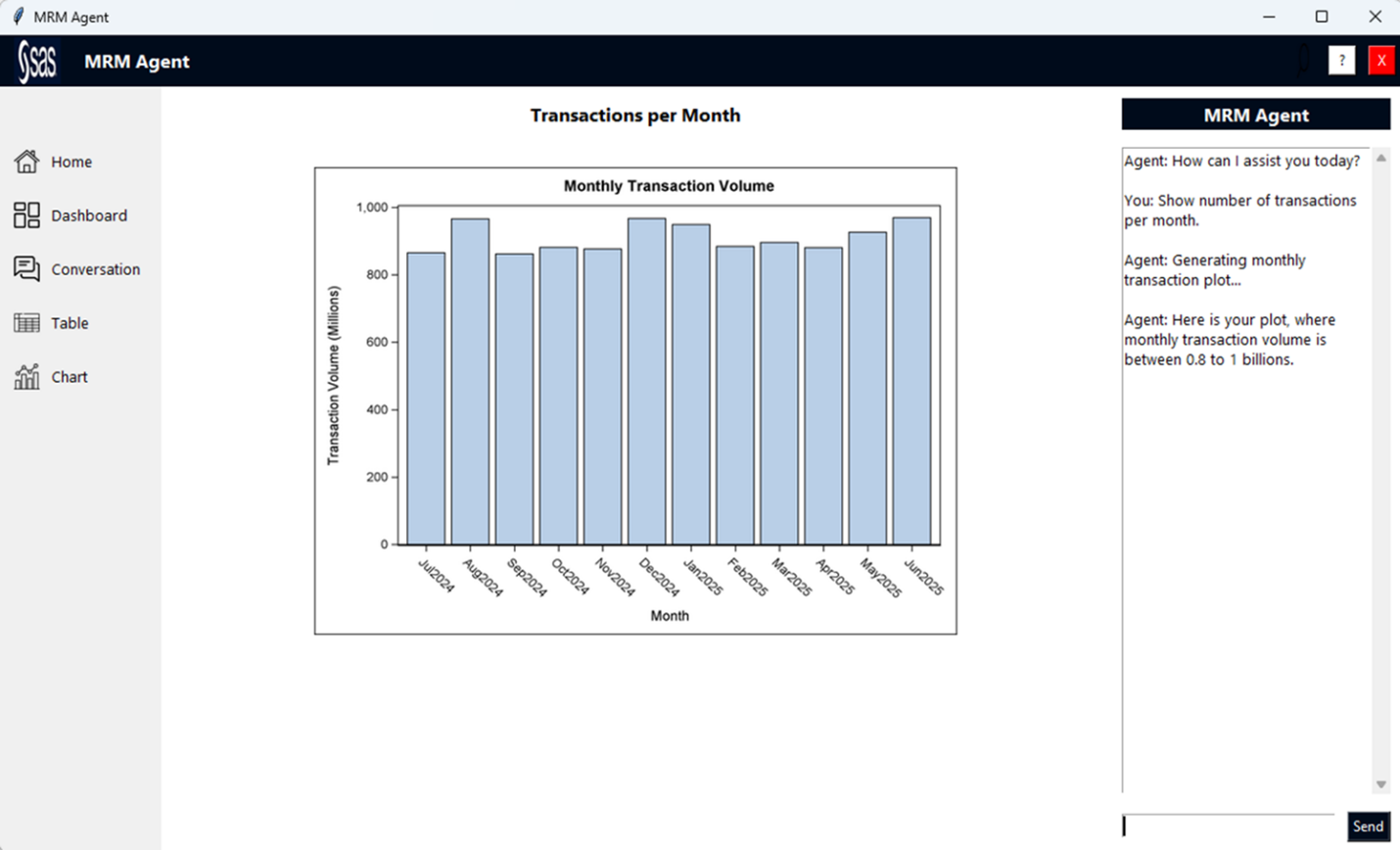
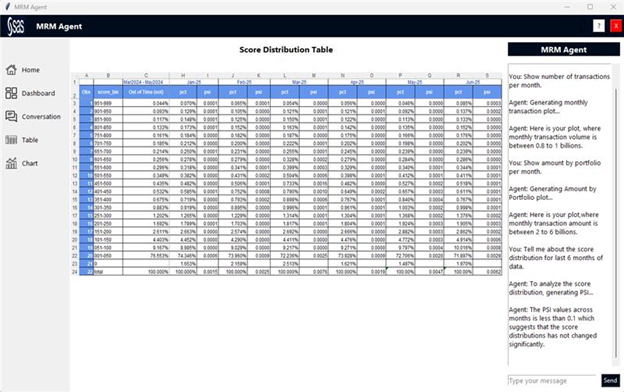
Figures 1, 2, and 3 illustrate how the MRM Agent Console retrieves relevant report content and performs real-time statistical analysis in response to a user query. Figure 1 demonstrates a sample of an inquiry-and-response flow. The user inquires about the monthly transaction volume associated with the loaded card authorization data. The MRM agent then generates a plot and summarizes the findings.
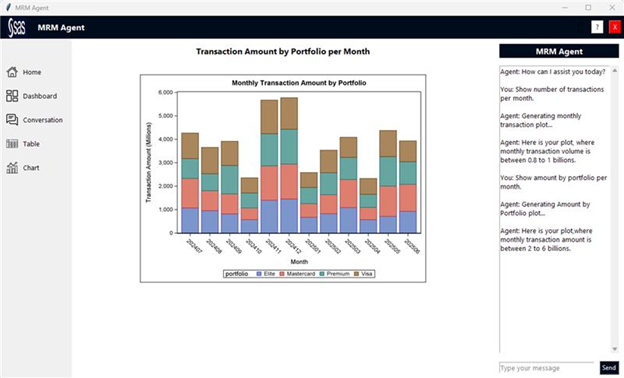
Another example of an inquiry-and-response flow is shown in Figure 2. A user asks about the monthly total transaction amount per portfolio for the loaded card authorization data. So, the MRM agent generates a plot, and the findings are summarized.
A third example of an inquiry-and-response is shown in Figure 3. A user inquires about the distribution of model scores over the last six months, and the MRM agent generates a PSI table and summary.
The Payoff: Generative AI’s impact on fraud detection
Banks that adopt conversational MRM for fraud detection can achieve more than just operational speed. They could secure clarity, control, and confidence across their model risk management processes and reporting.
Ultimately, adopting conversational MRM is a strategic move that can empower banks to lead with intelligence and resilience. By embracing Generative AI innovation, banks can position themselves not just to keep up, but to set the pace for the future of fraud models. This approach transforms model governance from a static compliance process into a dynamic, interactive one, where decisions are made instantly, confidently, and backed by real-time insights. By enabling conversational engagement, institutions shift from reactive reporting to proactive risk management, fostering transparency and agility across the entire lifecycle of fraud detection models.
Lili Li, PhD, Senior Data Scientist at SAS, specializes in statistical modeling, machine learning, and large-scale data integration. After earning her PhD from North Carolina State University, she played a pivotal role in developing JMP Clinical and JMP Genomics, advancing interactive visualization and exploratory analytics for life sciences. Since 2020, she has concentrated on advanced analytics consulting, leveraging predictive modeling, anomaly detection, and optimization techniques to support clients in financial risk assessment and fraud mitigation.
Derya Biryol, PhD, is a Senior Data Scientist at SAS. Since joining SAS in 2016, Derya has specialized in fraud detection modeling, model evaluation, and risk analytics. With a Ph.D. in Applied Mathematics, she brings deep expertise in advanced statistical methods and machine learning to develop and optimize real-time fraud detection solutions as part of the R&D Applied AI and Modeling team.
Artin Armagan, PhD, Sr Manager at SAS. Artin is a statistician working with a brilliant team of data scientists to build real-time transactional fraud-detection models for financial institutions. He has worked on analytical modeling across various business domains, including banking, insurance, and healthcare, throughout his tenure at SAS. Previously, he held postdoctoral positions at Duke University after completing his graduate studies at the University of Tennessee.