ESTIMATE Statements - the final installment

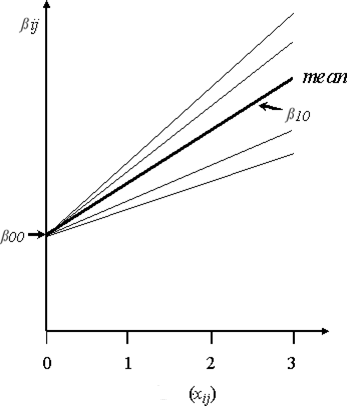
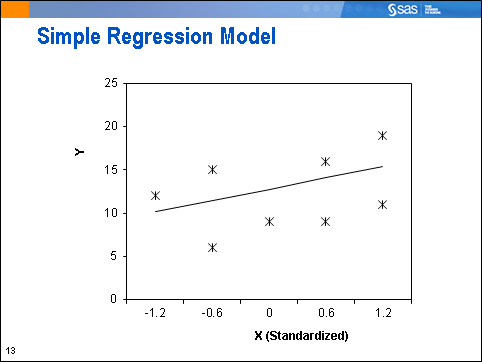
FINALLY…the simplest ESTIMATE statements to write are for continuous variables not involved in interactions or higher order terms. Consider a data set containing the 2004 SAT scores for each of the 50 states. The file includes the combined math and verbal SAT scores (TOTAL), the state (STATE) and the percent [...]

Post a Comment

"Easy button" for ESTIMATE statements

My previous blog demonstrated the most difficult type of ESTIMATE statement to write—a two-way (or higher) ANOVA with interactions. An “easy button” for ESTIMATE statement comes by having a simpler model. Models with only main effects and no interactions make writing ESTIMATE statements straightforward.  Consider first a one-way ANOVA. A [...]

Post a Comment

The magical ESTIMATE (and CONTRAST) statements

When asked to select the best (or worst) of something in a business setting, do you wish you had “magic glasses” to see the answer? PROC GLM and other statistical modeling procedures have their own versions of such an item with their ESTIMATE (and CONTRAST) statements. They allow you to [...]

Post a Comment

The Human Side of Statistical Process Control: Three Applications of SAS/QC You Might Not Have Thought About

When you think of statistical process control, or SPC for short, what industry first comes to your mind? In the past 10 or 15 years, diverse industries have begun to standardize processes and administrative tasks with statistical process control. While the top two bars of the industrial Pareto chart are [...]

Post a Comment

Who Ate My Lunch? Discriminant Thresholds to Reduce False Accusations

Lunch. For some workers, it’s the sweetest part of an otherwise bitter day at the grindstone. Nothing can turn that sweetness sour like going into the breakroom to discover that someone has taken your lunch and eaten it themselves. Nothing like that ever happens here at SAS. But if it [...]

Post a Comment

The Punchline: MANOVA or a Mixed Model?

Edited to add: Thanks for Larry Madger for noticing an important omission in my code below. I have updated the programs to include the response variables, which enables the responses to have different means. So, if you were reading last week, we talked about how to structure your data for [...]

Post a Comment

The Bayes theorem, explained to an above-average squirrel

Editor’s Note: The following question was recently asked of our statistical training instructors. Terry Woodfield, along with Bob Lucas took the time to write this eloquent and easily digestible answer. Question: I’m trying to get a general – very general – understanding what the Bayes theorem is, and is used [...]

Post a Comment

Data Structure for Repeated Measures Analysis... A Teaser

Next week’s blog entry will build on this one, so I want you to take notes, OK? It’s not headline news that in most cases, the best way to handle a repeated measures analysis is with a mixed models approach, especially for Normal reponses (for other distributions in the exponential [...]

Post a Comment

Discriminant Analysis, Priors, and Fairy-Selection

A student in my multivariate class last month asked a question about prior probability specifications in discriminant function analysis: What if I don’t know what the probabilities are in my population? Is it best to just use the default in PROC DISCRIM? First, a quick refresher of priors in discriminant [...]

Post a Comment

We Wanted to Call It "All the Statistics You Missed in B-School"

Happy New Year!! This is a good time to think about what was going on here in SAS Education one year ago, and to introduce you to a big project that I’m really excited to “take public.” In January 2010 (as well as throughout 2009), we kept getting cries for [...]

Post a Comment