The DO Loop
Statistical programming in SAS with an emphasis on SAS/IML programs

A popular way to use lists in the SAS/IML language is to pack together several related matrices into a single data structure that can be passed to a function. Imagine that you have written an algorithm that requires a dozen different parameters. Historically, you would have to pass those parameters
SAS/IML 14.3 (SAS 9.4M5) introduced a new syntax for creating lists and for assigning and extracting item in a list. Lists (introduced in SAS/IML 14.2) are data structures that are convenient for holding heterogeneous data. A single list can hold character matrices, numeric matrices, scalar values, and other lists, as
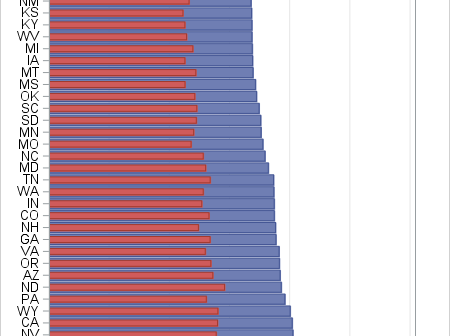
Money magazine (Jan/Feb 2018) contains an article about how much it costs to give birth in the US. The costs, which are based on insurance data, include prenatal care and hospital delivery but exclude infant care. The data are compiled for each state (including Washington, DC) and by type of