All Posts
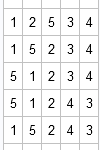

In a previous post, I discussed how to generate random permutations of N elements. But what if you want to systematically iterate through a list of ALL permutations of N elements? In the SAS DATA step you can use the ALLPERM subroutine in the SAS DATA step. For example, the


It is inspiring for me to see the determination of government employees working to provide us the level of service we have all grown accustomed to even in the midst of "The Great Recession". I don’t need to tell you that the need for government services goes up dramatically during
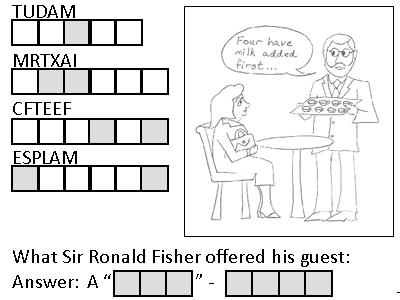
Today's post is a puzzle. Why? Well, my wife loves solving word puzzles, and today is our wedding anniversary. Last year, I bought her a Jumble® book. This year, I've created a one-of-a-kind scrambled word puzzle just for her. (But you can play, too!) I created this puzzle by using
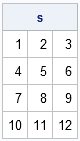
Sometimes it is convenient to reshape the data in a matrix. Suppose you have a 1 x 12 matrix. This same data can fit into several matrices with different dimensions: a 2 x 6 matrix, a 3 x 4 matrix, a 4 x 3 matrix, and so on. The SHAPE function enables you to specify the number of


Yesterday, I was in the #raganSAS audience as David Pogue told me What's New and What's Next in the world of technology. David is a great presenter, and he really had the audience engaged as he talked about augmented reality, his world according to Twitter, and an iPhone app that

If you're an administrator of systems that run SAS, you have probably already read up on How to Maintain Happy SAS 9 Users. If not, go read that first. Now, are you looking to squeeze the best performance out of SAS on Microsoft Windows 2008 Server? Be sure to read

My previous post on creating a random permutation started me thinking about word games. My wife loves to solve the daily Jumble® puzzle that runs in our local paper. The puzzle displays a string of letters like MLYBOS, and you attempt to unscramble the letters to make an ordinary word.
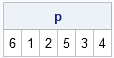
I recently read a paper that described a SAS macro to carry out a permutation test. The permutations were generated by PROC IML. (In fact, an internet search for the terms "SAS/IML" and "permutation test" gives dozens of papers in recent years.) The PROC IML code was not as efficient

A previous post described a simple algorithm for generating Fibonacci numbers. It was noted that the ratio between adjacent terms in the Fibonacci sequence approaches the "Golden Ratio," 1.61803399.... This post explains why. In a discussion with my fellow blogger, David Smith, I made the comment "any two numbers (at
Space is big. You just won't believe how vastly, hugely, mind-bogglingly big it is. I mean, you may think it's a long way down the road to the drug store, but that's just peanuts to space. - Douglas Adams, Hitchhiker's Guide to the Galaxy SAS is big. It's not quite

Often, the first step of a SAS/IML program is to use the USE, READ, and CLOSE statements to read data from a SAS data set into a vector or matrix. There are several ways to read data: Read variables into vectors of the same name. Read one or more variables

Since its 4.2 release, SAS Enterprise Guide has been able to import Microsoft Excel 2007 and 2010 spreadsheet files (usually encountered as .XLSX files). But while SAS Enterprise Guide can export XLS files (which are compatible with all versions of Microsoft Excel), it does not have the ability to export

In a previous blog post about hurricanes, I created a histogram of the occurrence of tropical cyclones in the Atlantic basin during the years 1988–2003. That histogram shows that the peak of hurricane activity occurs in the second week of September, but also that a majority of tropical storms occur

This morning I read an interesting post about the design of the new Twitter Web page. The post included some R code to generate the ratio between adjacent terms in the Fibonacci seqence. The ratio converges to the "Golden Ratio": 1.61803399.... I'm sure that many R gurus will post simpler
I saw a suggestion arrive from a SAS customer who would like to see the IN operator extended to allow ranges of date values. For example, you can currently write a program that checks for values IN a collection or range of numbers: data check; if x in (1:10) then