About this blog
Rick Wicklin, PhD, is a senior researcher in computational statistics at SAS and is a principal developer of PROC IML and SAS/IML Studio. His areas of expertise include computational statistics, statistical graphics, statistical simulation, and modern methods in statistical data analysis. Rick is author of the books Statistical Programming with SAS/IML Software and Simulating Data with SAS.
Follow @RickWicklin on Twitter.
Subscribe to this blog
Tags
Bootstrap and Resampling Data Analysis Efficiency Getting Started History IMLPlus Just for Fun Matrix Computations Numerical Analysis Reading and Writing Data Sampling and Simulation SAS/IML Studio SAS Programming Statistical Graphics Statistical Programming Statistical Thinking Tips and Techniques vectorizationArchives
Compute the log-determinant of a matrix
The determinant of a matrix arises in many statistical computations, such as in estimating parameters that fit a distribution to multivariate data. For example, if you are using a log-likelihood function to fit a multivariate normal distribution, the formula for the log-likelihood involves the expression log(det(Σ)), where Σ is the [...]
Post a Comment Open question in 1937...short SAS program today
John D. Cook posted a story about Hardy, Ramanujan, and Euler and discusses a conjecture in number theory from 1937. Cook says, Euler discovered 635,318,657 = 158^4 + 59^4 = 134^4 + 133^4 and that this was the smallest [integer] known to be the sum of two fourth powers in [...]
Post a Comment Visualize the bivariate normal cumulative distribution
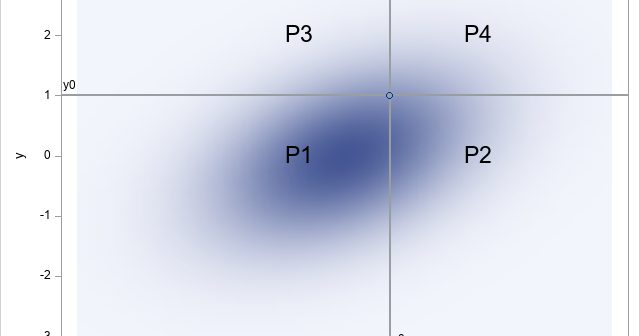
When you are working with probability distributions (normal, Poisson, exponential, and so forth), there are four essential functions that a statistical programmer needs. As I’ve written before, for common univariate distributions, SAS provides the following functions: the PDF function, which returns the probability density at a given point the CDF [...]
Post a Comment Convergence or divergence? A simple iteration with a random component
A collegue who works with time series sent me the following code snippet. He said that the calculation was overflowing and wanted to know if this was a bug in SAS: data A(drop=m); call streaminit(12345); m = 2; x = 0; do i = 1 to 5000; x = m*x [...]
Post a Comment The curious case of random eigenvalues
I’ve been a fan of statistical simulation and other kinds of computer experimentation for many years. For me, simulation is a good way to understand how the world of statistics works, and to formulate and test conjectures. Last week, while investigating the efficiency of the power method for finding dominant [...]
Post a Comment The power method: compute only the largest eigenvalue of a matrix
When I was at SAS Global Forum last week, a SAS user asked my advice regarding a SAS/IML program that he wrote. One step of the program was taking too long to run and he wondered if I could suggest a way to speed it up. The long-running step was [...]
Post a Comment The DIF function: Compute lagged differences and finite differences
To a statistician, the DIF function (which was introduced in SAS/IML 9.22) is useful for time series analysis. To a numerical analyst and a statistical programmer, the function has many other uses, including computing finite differences. The DIF function computes the difference between the original vector and a shifted version [...]
Post a Comment The LAG function: Useful for more than time series analysis
To a statistician, the LAG function (which was introduced in SAS/IML 9.22) is useful for time series analysis. To a numerical analyst and a statistical programmer, the function provides a convenient way to compute quantitites that involve adjacent values in any vector. The LAG function is essentially a “shift operator.” [...]
Post a Comment Generate a random matrix with specified eigenvalues
In a previous post I showed how to implement Stewart’s (1980) algorithm for generating random orthogonal matrices in SAS/IML software. By using the algorithm, it is easy to generate a random matrix that contains a specified set of eigenvalues. If D = diag(λ1, …, λp) is a diagonal matrix and [...]
Post a Comment Generating a random orthogonal matrix
Because I am writing a new book about simulating data in SAS, I have been doing a lot of reading and research about how to simulate various quantities. Random integers? Check! Random univariate samples? Check! Random multivariate samples? Check! Recently I’ve been researching how to generate random matrices. I’ve blogged [...]
Post a Comment