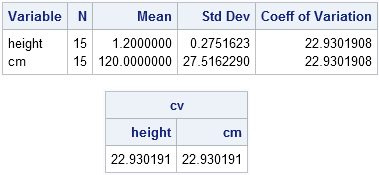
My wife got one of those electronic activity trackers a few months ago and has been diligently walking every day since then. At the end of the day she sometimes reads off how many steps she walked, as measured by her activity tracker. I am always impressed at how many
English
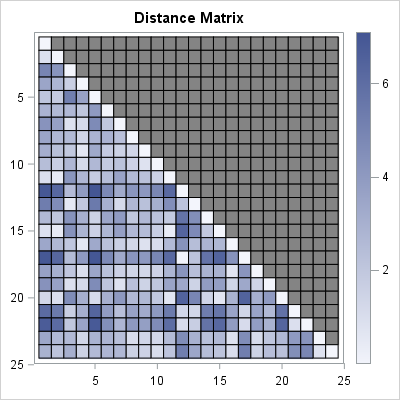
In a previous blog post, I showed how to use the graph template language (GTL) in SAS to create heat maps with a continuous color ramp. SAS/IML 13.1 includes the HEATMAPCONT subroutine, which makes it easy to create heat maps with continuous color ramps from SAS/IML matrices. Typical usage includes
Heat maps have many uses. In a previous article, I showed how to use heat maps with a discrete color ramp to visualize matrices that have a small number of unique values, such as certain covariance matrices and sparse matrices. You can also use heat maps with a continuous color
One of the things I enjoy about blogging is that I often learn something new. Last week I wrote about how to optimize a function that is defined in terms of an integral. While developing the program in the article, I made some mistakes that generated SAS/IML error messages. By
A SAS customer wrote, "I have access to PROC IML through SAS OnDemand for Academics. What is the best way for me to learn to program in the SAS/IML language? How do I get started with PROC IML?" That is an excellent question, and I'm happy to offer some suggestions.
The SAS/IML language is used for many kinds of computations, but three important numerical tasks are integration, optimization, and root finding. Recently a SAS customer asked for help with a problem that involved all three tasks. The customer had an objective function that was defined in terms of an integral.
Wisdom has built her house; She has hewn out her seven pillars. – Proverbs 9:1 At the 2014 Joint Statistical Meetings in Boston, Stephen Stigler gave the ASA President's Invited Address. In forty short minutes, Stigler laid out his response to the age-old question "What is statistics?" His answer was
In SAS software, you can use the QUAD subroutine in the SAS/IML language to evaluate definite integrals on an interval [a, b]. The integral is properly defined only for a < b, but mathematicians define the following convention, which enables you to make sense of reversing the limits of integration:
Unless you diligently read the "What's New" chapter for each release of SAS software, it is easy to miss new features that appear in the language. People who have been writing SAS/IML programs for decades are sometimes surprised when I tell them about a useful new function or programming feature.
In a previous blog post, I described how to generate combinations in SAS by using the ALLCOMB function in SAS/IML software. The ALLCOMB function in Base SAS is the equivalent function for DATA step programmers. Recall that a combination is a unique arrangement of k elements chosen from a set