English

Rick Wicklin 7
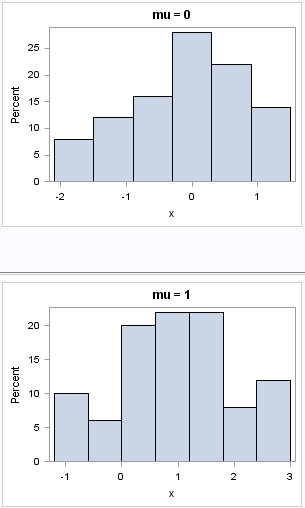
Skew this

The skewness of a distribution indicates whether a distribution is symmetric or not. A distribution that is symmetric about its mean has zero skewness. In contrast, if the right tail of a unimodal distribution has more mass than the left tail, then the distribution is said to be "right skewed"

Rick Wicklin 6
The frequency of letters in an English corpus

It's time for another blog post about ciphers. As I indicated in my previous blog post about substitution ciphers, the classical substitution cipher is no longer used to encrypt ultra-secret messages because the enciphered text is prone to a type of statistical attack known as frequency analysis. At the root

Rick Wicklin 3
Order variables by values of a statistic

When I create a graph of data that contains a categorical variable, I rarely want to display the categories in alphabetical order. For example, the box plot to the left is a plot of 10 standardized variables where the variables are ordered by their median value. The ordering makes it

Rick Wicklin 3
Ciphers, keys, and cryptoquotes

Today is my fourth blog-iversary: the anniversary of my first blog post in 2010. To celebrate, I am going to write a series of fun posts based on The Code Book by Simon Singh, a fascinating account of the history of cryptography from ancient times until the present. While reading

Rick Wicklin 2
How to create a hexagonal bin plot in SAS

While I was working on my recent blog post about two-dimensional binning, a colleague asked whether I would be discussing "the new hexagonal binning method that was added to the SURVEYREG procedure in SAS/STAT 13.2." I was intrigued: I was not aware that hexagonal binning had been added to a

Learn SAS
Rick Wicklin 5
Choosing bins for histograms in SAS

When you create a histogram with statistical software, the software uses the data (including the sample size) to automatically choose the width and location of the histogram bins. The resulting histogram is an attempt to balance statistical considerations, such as estimating the underlying density, and "human considerations," such as choosing

1 103 104 105 106 107 158