Use regression for a univariate analysis? Yes!

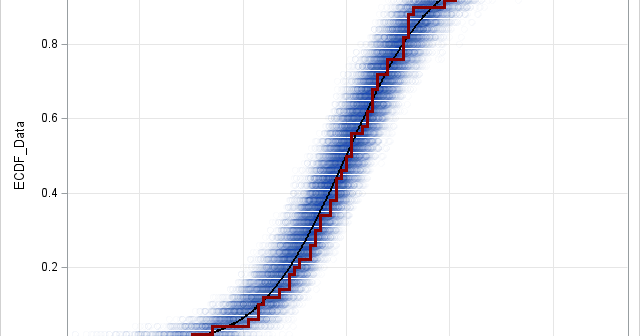
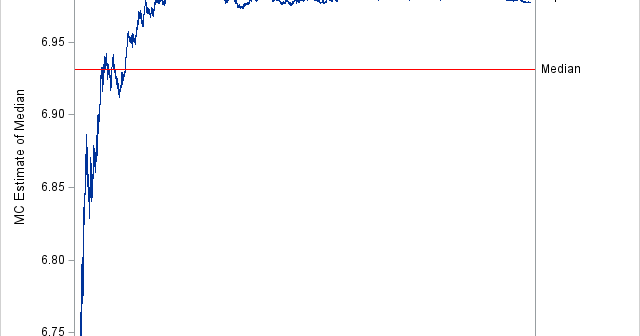
I’ve conducted a lot of univariate analyses in SAS, yet I’m always surprised when the best way to carry out the analysis uses a SAS regression procedure. I always think, “This is a univariate analysis! Why am I using a regression procedure? Doesn’t a regression require at least two variables?” [...]
Post a Comment

A three-panel visualization of a distribution

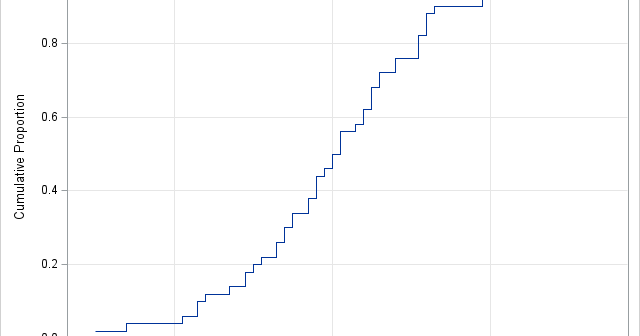
At a recent conference, I talked with a SAS customer who told me that he was using an R package to create a three-panel visualization of a distribution. Unfortunately, he couldn’t remember the name of the package, and he has not returned my e-mails, so the purpose of today’s article [...]
Post a Comment

Compute confidence intervals for percentiles in SAS

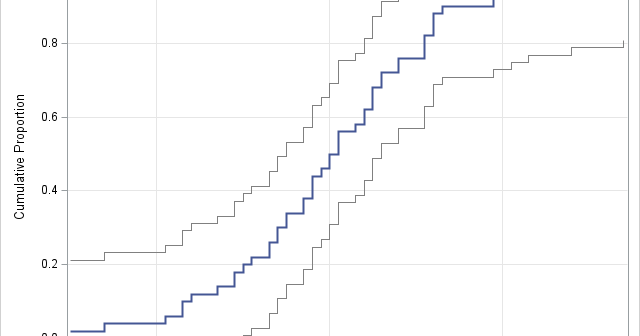
PROC UNIVARIATE has provided confidence intervals for standard percentiles (quartiles) for eons. However, in SAS 9.3M2 (featuring the 12.1 analytical procedures) you can use a new feature in PROC UNIVARIATE to compute confidence intervals for a specified list of percentiles. To be clear, percentiles and quantiles are essentially the same [...]
Post a Comment

Quantile regression: Better than connecting the sample quantiles of binned data

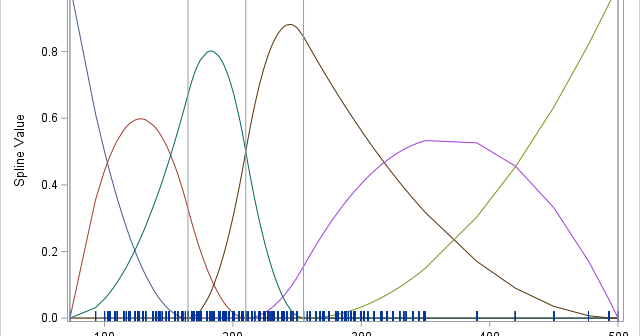
I often see variations of the following question posted on statistical discussion forums: I want to bin the X variable into a small number of values. For each bin, I want to draw the quartiles of the Y variable for that bin. Then I want to connect the corresponding quartile [...]
Post a Comment

The difference of density estimates: When does it make sense?

I was recently asked how to compute the difference between two density estimates in SAS. The person who asked the question sent me a link to a paper from The Review of Economics and Statistics that contains several examples of this technique (for example, see Figure 3 on p. 16 [...]
Post a Comment

How to compute the distance between observations in SAS

In statistics, distances between observations are used to form clusters, to identify outliers, and to estimate distributions. Distances are used in spatial statistics and in other application areas. There are many ways to define the distance between observations. I have previously written an article that explains Mahalanobis distance, which is [...]
Post a Comment

Got Matrix? Reach for the SAS/IML language

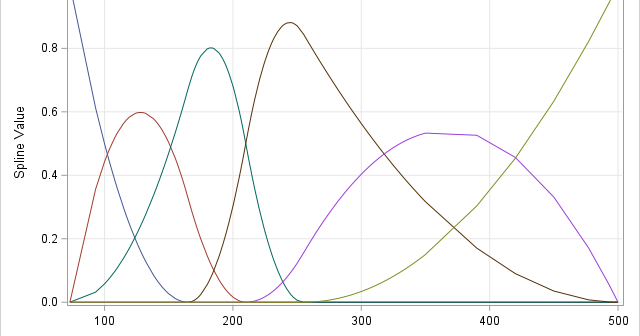
Someone recently asked a question on the SAS Support Communities about estimating parameters in ridge regression. I answered the question by pointing to a matrix formula in the SAS documentation. One of the advantages of the SAS/IML language is that you can implement matrix formulas in a natural way. The [...]
Post a Comment

The case of spilled coffee and the regression intercept

Argh! I’ve just spilled coffee on output that shows the least squares coefficients for a regression model that I was investigating. Now the parameter estimate for the intercept is completely obscured, although I can still see the parameter estimates for the coefficients of the continuous explanatory variable. What can I [...]
Post a Comment

SAS/IML Posters and Presentations at SAS Global Forum 2013

There is something for everyone at SAS Global Forum 2013. I like to attend presentations in the Statistics and Data Analysis track and talk with SAS customers in the SAS Support and Demo Area. But one activity that I enjoy the most is to stroll through the poster area and [...]
Post a Comment

How to use PROC SGPLOT to display the slope and intercept of a regression line

A SAS user asked an interesting question on the SAS/GRAPH and ODS Graphics Support Forum. The question is: Does PROC SGPLOT support a way to display the slope of the regression line that is computed by the REG statement? Recall that the REG statement in PROC SGPLOT fits and displays [...]
Post a Comment