SAS programmers are probably familiar with how SAS stores a character variable in a data set, but how is a character vector stored in the SAS/IML language? Recall that a character variable is stored by using a fixed-width storage structure. In the SAS DATA step, the maximum number of characters
Yearly Archives: 2014
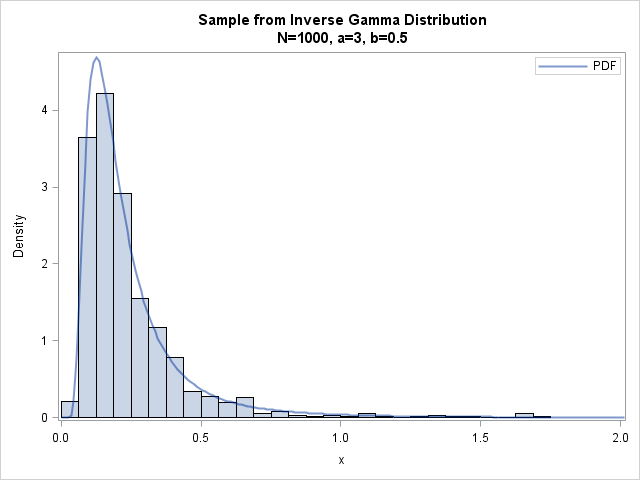
While at a conference recently, I was asked whether it was possible to use SAS to simulate data from an inverse gamma distribution. The SAS customer had looked at the documentation for the RAND function and did not see "inverse gamma" listed among the possible choices. The answer is "yes."
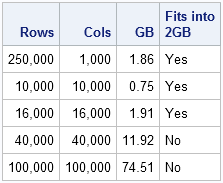
Dear Rick, I am trying to create a numerical matrix with 100,000 rows and columns in PROC IML. I get the following error: (execution) Unable to allocate sufficient memory. Can IML allocate a matrix of this size? What is wrong? Several times a month I see a variation of this
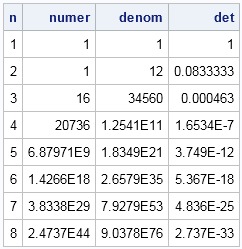
Just one last short article about properties of the Hilbert matrix. I've already blogged about how to construct a Hilbert matrix in the SAS/IML language and how to compute a formula for the determinant. One reason that the Hilbert matrix is a famous (some would say infamous!) example in numerical
I have previously written about the scope of local and global variables in the SAS/IML language. You might wonder whether SAS/IML modules can also have local scope. The answer is no. All SAS/IML modules are known globally and can be called by any other modules. Some object-oriented programming languages support
Last week I described the Hilbert matrix of size n, which is a famous square matrix in numerical linear algebra. It is famous partially because its inverse and its determinant have explicit formulas (that is, we know them exactly), but mainly because the matrix is ill-conditioned for moderate values of
I enjoy blogging about new functionality in the SAS/IML language because I can go into more depth and provide more complicated examples than the SAS/IML documentation. Today's article is a summary of all of my posts about features that were added to SAS/IML 12.1, which shipped in August 2012 as
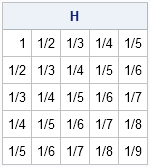
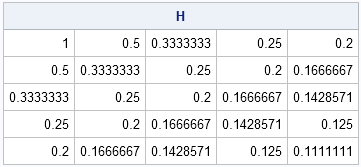
Yesterday I blogged about the Hilbert matrix. The (i,j)th element of the Hilbert matrix has the value 1 / (i+j-1), which is the reciprocal of an integer. However, the printed Hilbert matrix did not look exactly like the formula because the elements print as finite-precision decimals. For example, the last
The Hilbert matrix is the most famous ill-conditioned matrix in numerical linear algebra. It is often used in matrix computations to illustrate problems that arise when you compute with ill-conditioned matrices. The Hilbert matrix is symmetric and positive definite, properties that are often associated with "nice" and "tame" matrices. The
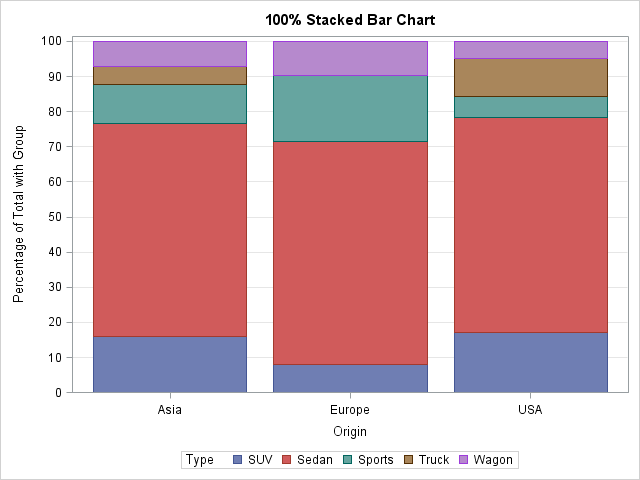
I enjoy reading the Graphically Speaking blog because it teaches me a lot about ODS statistical graphics, especially features of the SGPLOT procedure and the Graph Template Language (GTL). Yesterday Sanjay blogged about how to construct a stacked bar chart of percentages so that each bar represents 100%. His chart