Children in primary school learn that every positive number has a real square root. The number x is a square root of s, if x2 = s. Did you know that matrices can also have square roots? For certain matrices S, you can find another matrix X such that X*X
English
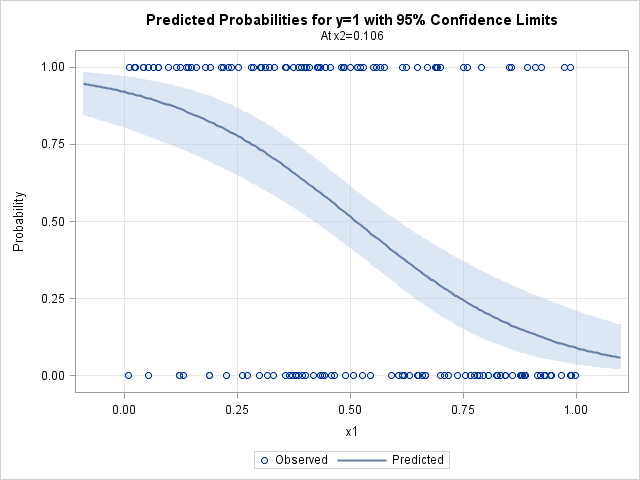
SAS software can fit many different kinds of regression models. In fact a common question on the SAS Support Communities is "how do I fit a <name> regression model in SAS?" And within that category, the most frequent questions involve how to fit various logistic regression models in SAS. There
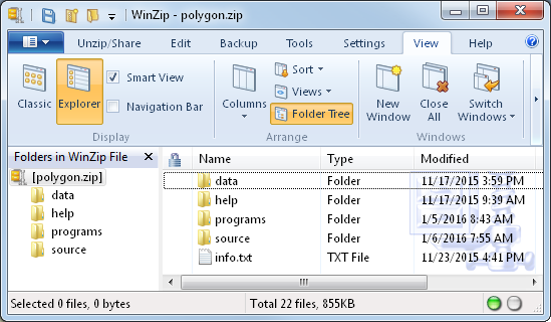
In a previous post I showed how to download, install, and use packages in SAS/IML 14.1. SAS/IML packages incorporate source files, documentation, data sets, and sample programs into a ZIP file. The PACKAGE statement enables you to install, uninstall, and manage packages. You can load functions and data into your
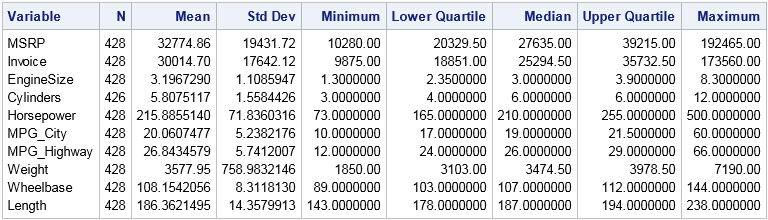
Descriptive univariate statistics are the foundation of data analysis. Before you create a statistical model for new data, you should examine descriptive univariate statistics such as the mean, standard deviation, quantiles, and the number of nonmissing observations. In SAS, there is an easy way to create a data set that
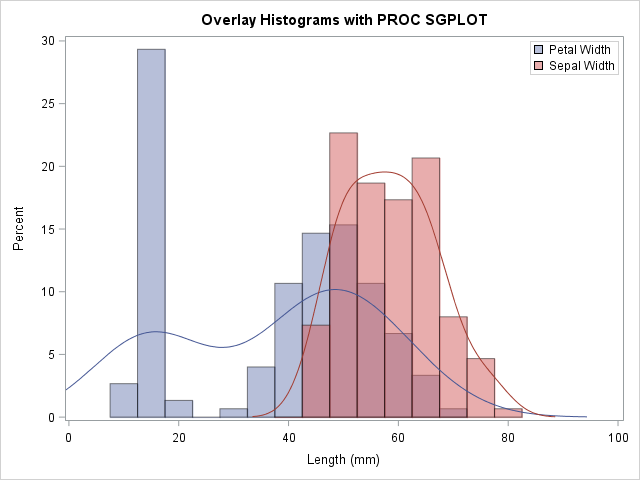
You can use histograms to visualize the distribution of data. A comparative histogram enables you to compare two or more distributions, which usually represent subpopulations in the data. Common subpopulations include males versus females or a control group versus an experimental group. There are two common ways to construct a
Most SAS regression procedures support the "stars and bars" operators, which enable you to create models that include main effects and all higher-order interaction effects. You can also easily create models that include all n-way interactions up to a specified value of n. However, it can be a challenge to
Last week I showed how to create dummy variables in SAS by using the GLMMOD procedure. The procedure enables you to create design matrices that encode continuous variables, categorical variables, and their interactions. You can use dummy variables to replace categorical variables in procedures that do not support a CLASS
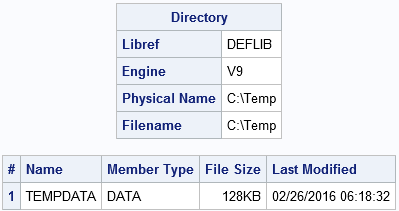
One of the first things SAS programmers learn is that SAS data sets can be specified in two ways. You can use a two-level name such as "sashelp.class" which uses a SAS libref (SASHELP) and a member name (CLASS) to specify the location of the data set. Alternatively, you can
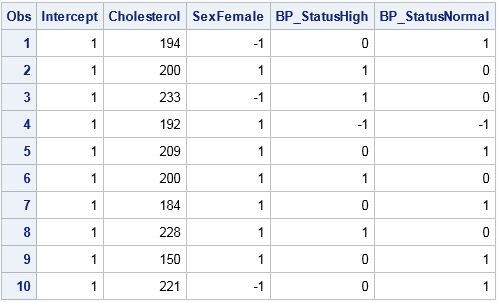
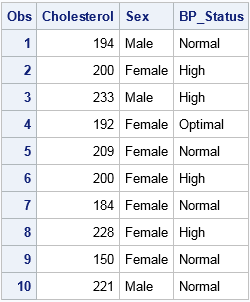
SAS programmers sometimes ask, "How do I create a design matrix in SAS?" A design matrix is a numerical matrix that represents the explanatory variables in regression models. In simple models, the design matrix contains one column for each continuous variable and multiple columns (called dummy variables) for each classification
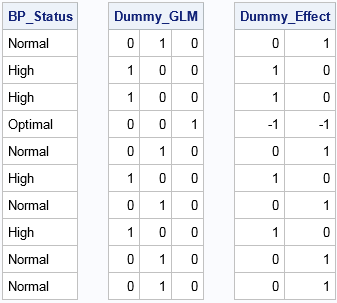
A dummy variable (also known as indicator variable) is a numeric variable that indicates the presence or absence of some level of a categorical variable. The word "dummy" does not imply that these variables are not smart. Rather, dummy variables serve as a substitute or a proxy for a categorical