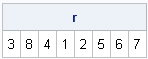
When your data are in rows, but you need them in columns, use the matrix transpose function or operator. The same advice applies to data in columns that you want to be in rows. For example, the vectors created by the DO function and the index creation operator are row
English
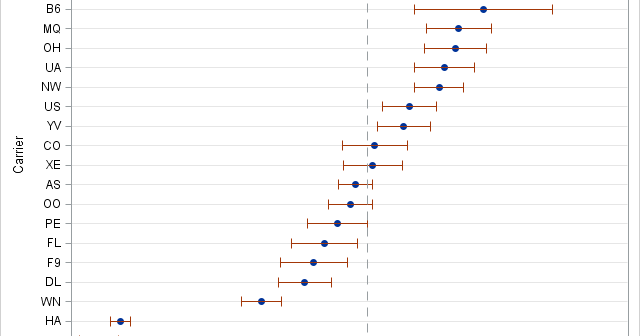
A colleague related the following story: He was taking notes at a meeting that was attended by a fairly large group of people (about 20). As each person made a comment or presented information, he recorded the two-letter initials of the person who spoke. After the meeting was over, he
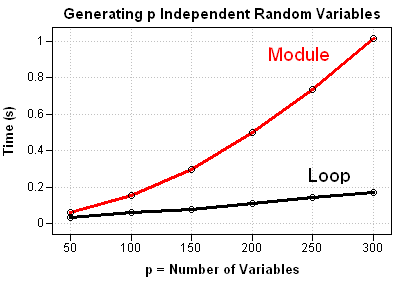
SAS/IML software is often used for sampling and simulation studies. For simulating data from univariate distributions, the RANDSEED and RANDGEN subroutines suffice to sample from a wide range of distributions. (I use the terms "sampling from a distribution" and "simulating data from a distribution" interchangeably.) For multivariate simulations, the IMLMLIB
It is often useful to create a vector with elements that follow an arithmetic sequence. For example, {1, 2, 3, 4} and {10, 30, 50, 70} are vectors with evenly spaced values. This post describes several ways to create vectors such as these. The SAS/IML language has two ways to
Computing probabilities can be tricky. And if you are a statistician and you get them wrong, you feel pretty foolish. That's why I like to run a quick simulation just to make sure that the numbers that I think are correct are, in fact, correct. My last post of 2010
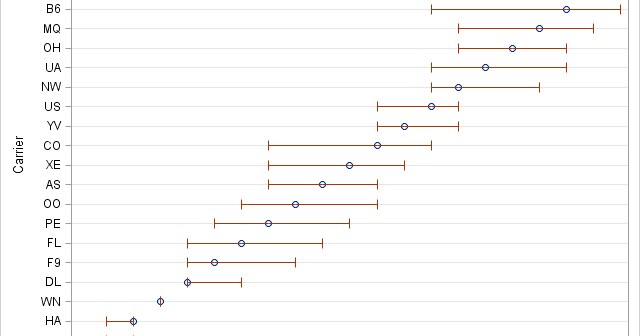
The Junk Chart blog discusses problems with a chart which (poorly) presents statistics on the prevalence of shark attacks by different species. Here is the same data presented by overlaying two bar charts by using the SGPLOT procedure. I think this approach works well because the number of deaths is
Over at the SAS/IML Discussion Forum, someone posted an interesting question about how to create a special matrix that contains all combinations of zeros and ones for a given size. Specifically, the problem is as follows. Given an integer n ≥ 1, produce a matrix with 2n rows and n
It's a New Year and I'm ready to make some resolutions. Last year I launched this blog with my Hello, World post in which I said: In this blog I intend to discuss, describe, and disseminate ideas related to statistical programming with the SAS/IML language.... I will present tips and
In many families, siblings draw names so that each family member and spouse gives and receives exactly one present. This year there was a little bit of controversy when a family member noticed that once again she was assigned to give presents to me. This post includes my response to
When I wake up early to write my blog, I often wonder, "Is anyone going to read this?" Apparently so. I started writing The DO Loop in September, 2010. Since then, I've posted about 60 entries about statistical programming with SAS/IML software. Since this is a statistical blog, it is