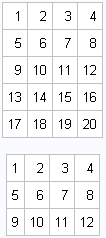
If you write an n x p matrix from PROC IML to a SAS data set, you'll get a data set with n rows and p columns. For some applications, it is more convenient to write the matrix in a "long format" with np observations and three columns. The first
For several years, there has been interest in calling R from SAS software, primarily because of the large number of special-purpose R packages. The ability to call R from SAS has been available in SAS/IML since 2009. Previous blog posts about R include a video on how to call R
When I call R from within the SAS/IML language, I often pass parameters from SAS into R. This feature enables me to write general-purpose, reusable, modules that can analyze data from many different data sets. I've previously blogged about how to pass values to SAS procedures from PROC IML by
In using a vector-matrix language such as SAS/IML, MATLAB, or R, one of the challenges for programmers is learning how to vectorize computations. Often it is not intuitive how to program a computation so that you avoid looping over the rows and columns of a matrix. However, there are a
While sorting through an old pile of papers, I discovered notes from a 2012 SAS conference that I had attended. Next to the abstract for one presentation, I had scrawled a note to myself that read "BLOG about the incomplete beta function!" Okay, Rick, whatever you say! In statistics, the
My daughter's middle school math class recently reviewed how to compute the greatest common factor (GCF) and the least common multiple (LCM) of a set of integers. (The GCF is sometimes called the greatest common divisor, or GCD.) Both algorithms require factoring integers into a product of primes. While helping
The mosaic plot is a graphical visualization of a frequency table. In a previous post, I showed how to use the FREQ procedure to create a mosaic plot. This article shows how to create a mosaic plot by using the MOSAICPARM statement in the graph template language (GTL). (The MOSAICPARM
Mosaic plots (Hartigan and Kleiner, 1981; Friendly, 1994, JASA) are used for exploratory data analysis of categorical data. Mosaic plots have been available for decades in SAS products such as JMP, SAS/INSIGHT, and SAS/IML Studio. However, not all SAS customers have access to these specialized products, so I am pleased
I was looking at someone else's SAS/IML program when I saw this line of code: y = sqrt(x<>0); The statement uses the element maximum operator (<>) in the SAS/IML language to make sure that negative value are never passed to the square root function. This little trick is a real
If you've ever tried to use PROC FREQ to create a frequency table of two character variables, you know that by default the categories for each variable are displayed in alphabetical order. A different order is sometimes more useful. For example, consider the following two-way table for the smoking status