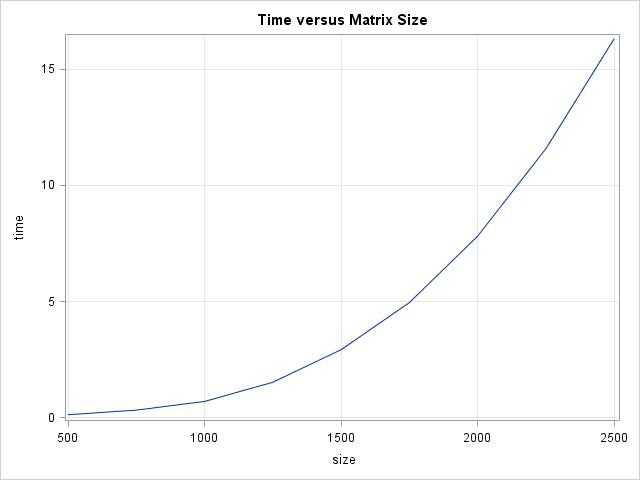
I often blog about the usefulness of vectorization in the SAS/IML language. A one-sentence summary of vectorization is "execute a small number of statements that each analyze a lot of data." In general, for matrix languages (SAS/IML, MATLAB, R, ...) vectorization is more efficient than the alternative, which is to
Uncategorized
In my previous post, I showed how to approximate a cumulative density function (CDF) by evaluating only the probability density function. The technique uses the trapezoidal rule of integration to approximate the CDF from the PDF. For common probability distributions, you can use the CDF function in Base SAS to
Evaluating a cumulative distribution function (CDF) can be an expensive operation. Each time you evaluate the CDF for a continuous probability distribution, the software has to perform a numerical integration. (Recall that the CDF at a point x is the integral under the probability density function (PDF) where x is
Last week I received a message from SAS Technical Support saying that a customer's IML program was running slowly. Could I look at it to see whether it could be improved? What I discovered is a good reminder about the importance of vectorizing user-defined modules. The program in this blog
I recently wrote about how to overlay multiple curves on a single graph by reshaping wide data (with many variables) into long data (with a grouping variable). The implementation used PROC TRANSPOSE, which is a procedure in Base SAS. When you program in the SAS/IML language, you might encounter data
Data. To a statistician, data are the observed values. To a SAS programmer, analyzing data requires knowledge of the values and how the data are arranged in a data set. Sometimes the data are in a "wide form" in which there are many variables. However, to perform a certain analysis
SAS procedures usually handle missing values automatically. Univariate procedures such as PROC MEANS automatically delete missing values when computing basic descriptive statistics. Many multivariate procedures such as PROC REG delete an entire observation if any variable in the analysis has a missing value. This is called listwise deletion or using
When you have a long-running SAS/IML program, it is sometimes useful to be able to monitor the progress of the program. For example, suppose you need to computing statistics for 1,000 different data sets and each computation takes between 5 and 30 seconds. You might want to output a message
Friends have to look out for each other. Sometimes this can be slightly embarrassing. At lunch you might need to tell a friend that he has some tomato sauce on his chin. Or that she has a little spinach stuck between her teeth. Or you might need to tell your
The xkcd comic often makes me think and laugh. The comic features physics, math, and statistics among its topics. Many years ago, the comic showed a "binary heart": a grid of binary (0/1) numbers with the certain numbers colored red so that they formed a heart. Some years later, I