I recently posted an article about self-similar structures that arise in Pascal's triangle. Did you know that the Kronecker product (or direct product) can be used to create matrices that have self-similar structure?
The basic idea is to start with a 0/1 matrix and compute a sequence of direct products of the matrix with itself. If M is a matrix that contains only zeros and ones, then M@M is a block matrix where a block of zeros occurs where M has a 0, and a copy of M appears where M has a 1, as shown by the following SAS/IML program:
proc iml;
M = {0 1 0,
     1 1 1,
     0 1 0};
M2 = M @ M;
print M2; |
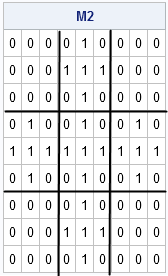
In this example, the original matrix, M, is 3 x 3. The matrix M@M is a 3 x 3 block matrix, where each block is either the zero matrix or a copy of M. If you apply the Kronecker product again and form the matrix M@M@M, you will get a 9 x 9 block matrix, where each block is either the zero matrix or a copy of M.
You can continue this process. The k-fold product of M with itself is a 3k x 3k matrix. Arthur Charpentier provides a nice animation of this iterative process on his Freakonometrics blog, which is where I first read about using the Kronecker product of a 0/1 matrix to create a self-similar structure. If you like to read articles about mathematical aspects of probability and statistics, I highly recommend Charpentier's well-written and always interesting blog.
Printing a 0/1 matrix is not an effective visualization. Instead, I will create a two-color heat map by using the HEATMAPDISC subroutine in SAS/IML 13.1. Because I want to create several heat maps, I wrote the following SAS/IML module that composes a matrix with itself k times and draws a two-color heat map of the result. The following heat map shows the structure of the four-fold Kronecker product M@M@M@M:
start KroneckerPlot(M, Iters);
   N = 1;
   do i = 1 to Iters;
      N = N @ M;
   end;
   call heatmapdisc(N) title="Iteration: "+strip(char(Iters))
        colorramp={White Blue} displayoutlines=0 ShowLegend=0;
finish;

ods graphics / width=800px height=800px;
run KroneckerPlot(M, 4); |
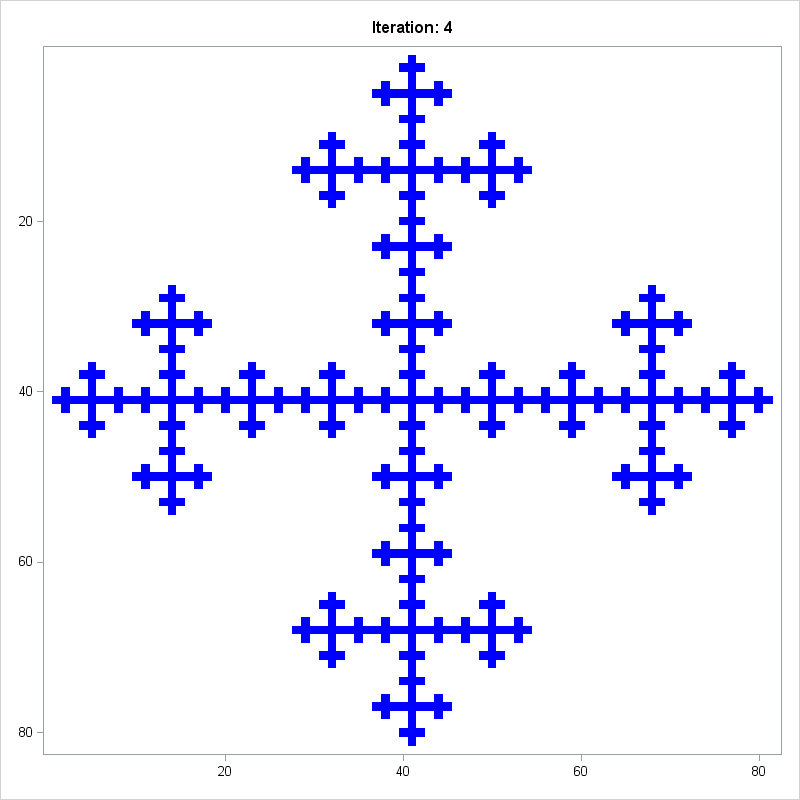
Let's say it all together: "Ooooooh!" "Ahhhhh!"
The structures that you can create depend on the arrangement of zeros and ones in the original matrix. Notice that these product matrices get big fast: the k-fold Kronecker product of an n x n matrix is an nk x nk matrix. You might run out of memory if you try to visualize a k-fold product when k or n is greater than 5. The next statements start with a 4 x 4 matrix and display a heat map for the five-fold product, which is a 1024 x 1024 matrix:
M = {1 1 1 1,
     1 1 0 0,
     1 0 1 0,
     1 0 0 1};
run KroneckerPlot(M, 5); /* 5 iterations of 4x4 matrix ==> 1024 x 1024 matrix */ |
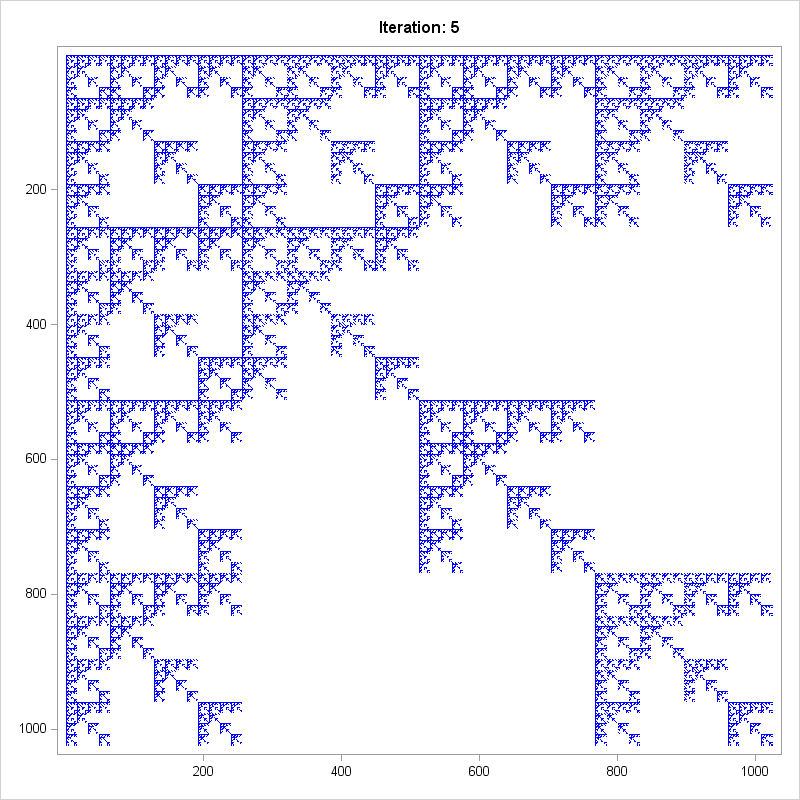
I call this image "Landing at LaGuardia."
Obviously you can create other structures. You can even generate random structures by using the Bernoulli distribution to create a random 0/1 matrix. I leave you with a few additional statements that create self-similar images. Feel free to create your own matrices. Leave a comment and tell me your favorite matrix for creating a self-similar structure.
ods graphics / width=500px height=500px;
M = {1 1 1 1,
     1 0 0 1,
     1 0 0 1,
     1 1 1 1};
run KroneckerPlot(M, 4);

/* Make random fractal plots! */
call randseed(54321);
do i = 1 to 5;
   M = randfun({4 4}, "Bernoulli", 0.75);
   run KroneckerPlot(M, 3);
end; |