Reading special SAS data sets into matrices

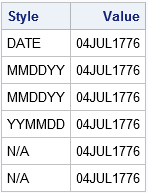
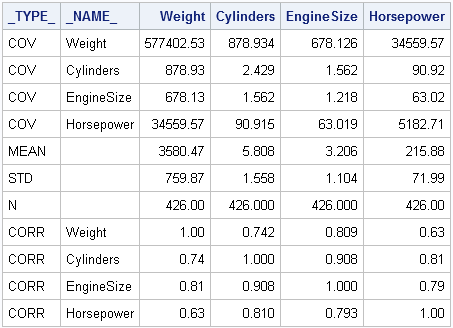
SAS has several kinds of special data sets whose contents are organized according to certain conventions. These special data sets are marked with the TYPE= data set attribute. For example, the CORR procedure can create a data set with the TYPE=CORR attribute. You can decipher the structure of the data [...]
Post a Comment

Reading big data in the SAS/IML language

A SAS/IML user on a discussion forum was trying to read data into a SAS/IML matrix, but the data was so large that it would not fit into memory. (Recall that SAS/IML matrices are kept in RAM.) After a few questions, it turned out that the user was trying to [...]
Post a Comment

How to get data values out of ODS graphics

Many SAS procedures can produce ODS statistical graphics as naturally as they produce tables. Did you know that it is possible to obtain the numbers underlying an ODS statistical graph? This post shows how. Suppose that a SAS procedure creates a graph that displays a curve and that you want [...]
Post a Comment

Indexing a SAS data set to improve processing categories in SAS/IML

I have blogged about three different SAS/IML techniques that iterate over categories and process the observations in each category. The three techniques are as follows: Use a WHERE clause on the READ statement to read only the observations in the ith category. This is described in the article “BY-group processing [...]
Post a Comment

How to read data set variables into SAS/IML vectors

One of the first skills that a beginning SAS/IML programmer learns is how to read data from a SAS data set into SAS/IML vectors. (Alternatively, you can read data into a matrix). The beginner is sometimes confused about the syntax of the READ statement: do you specify the names of [...]
Post a Comment

Creating symmetric matrices: Two useful functions with strange names

Covariance, correlation, and distance matrices are a few examples of symmetric matrices that are frequently encountered in statistics. When you create a symmetric matrix, you only need to specify the lower triangular portion of the matrix. The VECH and SQRVECH functions, which were introduced in SAS/IML 9.3, are two functions [...]
Post a Comment

Reading ALL variables INTO a matrix

The SAS/IML READ statement has a few convenient features for reading data from SAS data sets. One is that you can read all variables into vectors of the same names by using the _ALL_ keyword. The following DATA steps create a data set called Mixed that contains three numeric and [...]
Post a Comment

Reading variables with a common prefix

I got an email asking the following question: In the following program, I don’t know how many variables are in the data set A. However, I do know that the variable names are X1–Xk for some value of k. How can I read them all into a SAS/IML matrix when [...]
Post a Comment

Reshape data so that each category becomes a new variable

Being able to reshape data is a useful skill in data analysis. Most of the time you can use the TRANSPOSE procedure or the SAS DATA step to reshape your data. But the SAS/IML language can be handy, too. I only use PROC TRANSPOSE a few times per year, so [...]
Post a Comment

Random access: How to read specific observations in SAS/IML software

This article shows how to randomly access data in a SAS data set by using the READ POINT statement in SAS/IML software. I have previously discussed how to use the READ NEXT and READ CURRENT statements to sequentially access each observation in a SAS data set from PROC IML. Reading [...]
Post a Comment