JMP Clinical at CDISC European Interchange

Every year, the Clinical Data Interchange Standards Consortium (CDISC) holds several Interchange events that take place in the US, Europe and Asia. These meetings have several goals: to give CDISC users the opportunity to present solutions to data challenges that arise in the day-to-day use of these standards; to provide new or [...]

Post a Comment

JMP Clinical present at PhUSE, Brighton 2011

The Pharmaceutical Users Software Exchange (PhUSE) conference in the British seaside resort of Brighton was nearly two months ago, but I am still thinking about it; PhUSE provided an opportunity to learn from experts and share ideas about the application of software in the pharmaceutical industry. The theme for this [...]

Post a Comment

Accounting for the time at which an adverse event occurs

In a previous post, I described how JMP Clinical allows you to specify time windows within an incidence analysis. Specifying time windows can provide a more informative analysis since it is possible to view how the risk of adverse events (AEs) changes over the course of a clinical trial. However, the [...]

Post a Comment

Discovering unreported adverse events using your findings data

When designing case report forms (CRFs) for a clinical trial, it is important to minimize or eliminate redundancies in the collected information. Such redundancies can lead to inconsistencies that require a query to the clinical site for resolution. In a poorly designed CRF, data conflicts can be so numerous that [...]

Post a Comment

Summarizing the incidence of adverse events

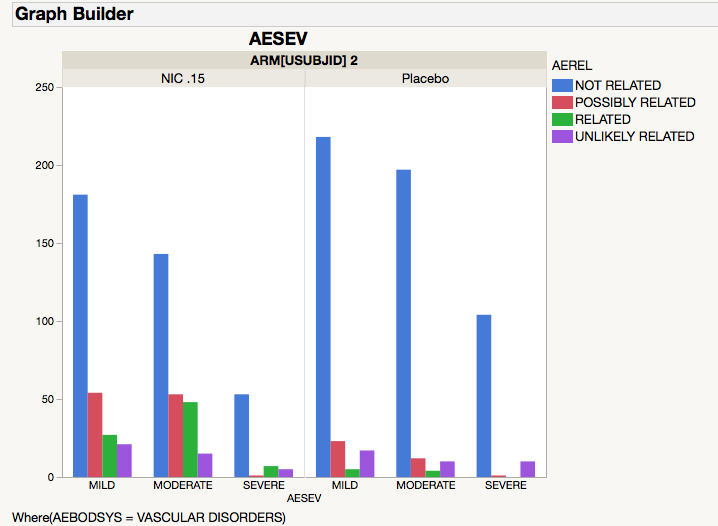
The analysis of adverse events (AEs) suffers from the problem of dimensionality. It is impossible to predict what AEs will occur on study, and there are often numerous events by study’s end. Typically, the incidence of adverse events is summarized in tables, with events coded by a medical dictionary, such [...]

Post a Comment

JMP Clinical 3.1 generates adverse event narratives

In a clinical trial, when a subject has a serious adverse event (SAE) or other significant adverse event (AE), such as those leading to the discontinuation of the study, a narrative is written for the clinical study report. These narratives summarize the details surrounding the event to enable understanding of [...]

Post a Comment

People Behind JMP Software: Russ Wolfinger

Today, we’re releasing the latest version of JMP Clinical and would like to introduce you to someone who is essential to this product (as well as JMP Genomics): Russ Wolfinger. You may know him as a blogger in this space, but Russ’ real job at JMP is Director of Scientific [...]

Post a Comment

JMP Add-Ins: Super Extensibility, Baby!

Congratulations to the Cheeseheads on their Super Bowl victory. As a fan of that pro-sports desolate wasteland known as Cleveland, and despite a conflicting desire to demonstrate league superiority of the AFC North, I found myself pulling for the team in green (plus I love cheese). Nice to see a [...]

Post a Comment

Releasing JMP Genomics 5

I am very excited to announce the release of JMP Genomics 5! Our latest version provides many new tools for downstream analysis of large genomics data sets. We’ve incorporated enhancements across almost all functional areas of the product – expression, SNP, copy number, predictive modeling, and enrichment analysis. You can [...]

Post a Comment

JMP Life Sciences Seminars Starts in Great Lakes Area

We kicked off the JMP Life Sciences seminar series in Indianapolis on Tuesday, October 5, with the JMP Great Lakes team: Account Executive Dan Durkin and Systems Engineer Sam Gardner. The venue and setup for the seminar at the Westin Indianapolis was absolutely fantastic, and the room was full of [...]

Post a Comment